What is signaling in the context of informational problems?
Signaling is when the informed party takes action to reveal their private information to the uninformed party to reduce information asymmetry.
How does a warranty act as a signal in a used car sale?
A warranty signals that the car is likely in good condition because the seller is willing to cover repairs, indicating confidence in the product.
Why might a college degree serve as a signal to employers?
A college degree signals to employers that the applicant is likely smart and capable, as it demonstrates the ability to complete higher education.
What is screening in the context of informational problems?
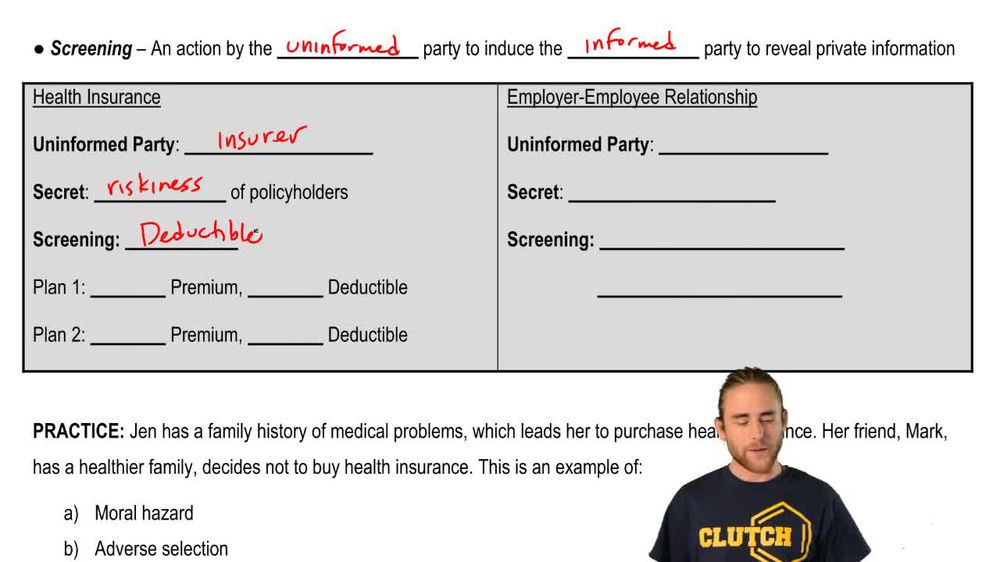
Screening is when the uninformed party takes action to induce the informed party to reveal their private information.
How do health insurers use deductibles as a screening tool?
Health insurers offer plans with different deductibles to separate risky policyholders from less risky ones, as risky individuals prefer lower deductibles.
What is the difference between signaling and screening?
Signaling is initiated by the informed party to reveal information, while screening is initiated by the uninformed party to extract information.
How does commission-based pay help employers screen employees?
Commission-based pay attracts hard-working employees and discourages those who might slack off, as only motivated workers prefer performance-based compensation.
What is meant by 'shirking' in economics?
Shirking refers to employees slacking off or not working as hard as they should.
How do year-end bonuses function as a screening mechanism?
Year-end bonuses incentivize employees to work harder throughout the year, helping employers identify and reward diligent workers.
Why do risky health insurance customers prefer low deductibles?
Risky customers expect to use insurance more often and want to avoid high out-of-pocket costs, so they choose plans with low deductibles.
How does offering multiple insurance plans help insurers screen customers?
By offering plans with different premiums and deductibles, insurers can separate customers based on their expected risk and usage.
What problem do signaling and screening aim to solve?
They aim to reduce information asymmetry, which can lead to adverse selection and moral hazard in markets.
Give an example of signaling outside of car sales or job applications.
A company might signal product quality by offering a money-back guarantee, showing confidence in their product.
What is adverse selection and how do signaling and screening address it?
Adverse selection is when one party has more information than the other, leading to poor market outcomes; signaling and screening help reveal hidden information to improve decisions.
How do incentives like commission and bonuses reduce moral hazard?
They align employees' interests with the employer's goals, encouraging hard work and reducing the temptation to shirk responsibilities.
 Back
Back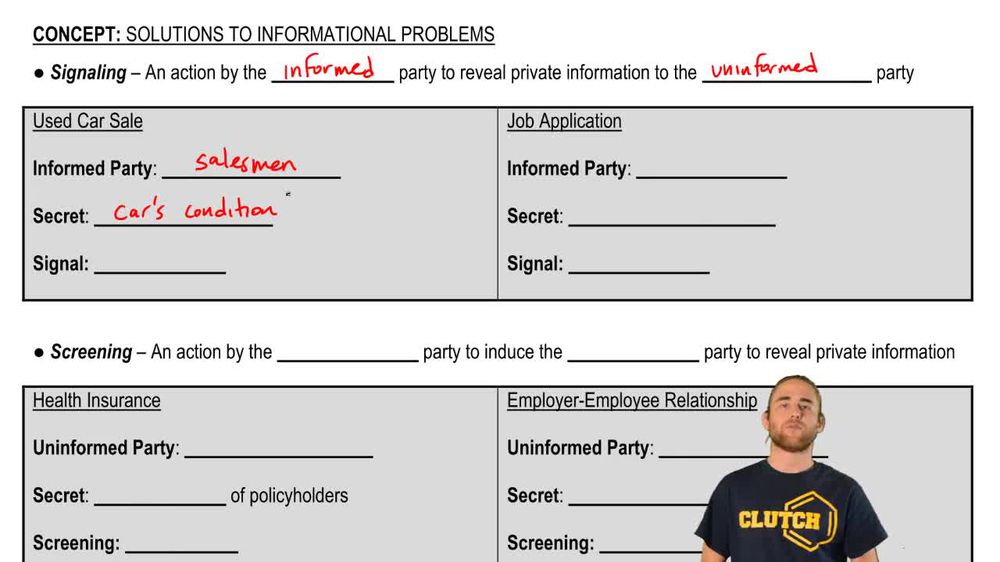
 03:06
03:06