Skip to main content
Macroeconomics
My Course
Learn
Exam Prep
AI Tutor
Study Guides
Flashcards
Explore
Try the app
My Course
Learn
Exam Prep
AI Tutor
Study Guides
Flashcards
Explore
Try the app
Back
Shortcomings of GDP definitions
You can tap to flip the card.
GDP
You can tap to flip the card.
👆
GDP
A measure of total economic production, often used as a proxy for national well-being, but with notable limitations.
Track progress
Control buttons has been changed to "navigation" mode.
1/14
Related flashcards
Related practice
Recommended videos
Shortcomings of GDP quiz #1
Shortcomings of GDP
17 Terms
Shortcomings of GDP
10. Measuring National Output and Income
10 problems
Topic
Other Measures of Total Production and Total Income
10. Measuring National Output and Income
10 problems
Topic
11. Gross Domestic Product (GDP) and Consumer Price Index (CPI)
7 topics
10 problems
Chapter
02:21
Shortcomings of GDP
2
views
Terms in this set (14)
Hide definitions
GDP
A measure of total economic production, often used as a proxy for national well-being, but with notable limitations.
Household Production
Economic activities like homemaking or cooking at home, which contribute value but are excluded from official economic measures.
Underground Economy
Market transactions hidden from government oversight, including illegal trade and tax evasion, not reflected in official statistics.
Leisure
Non-work time that enhances well-being but is not captured in economic output calculations.
Income Distribution
The way total economic output is shared among citizens, which can be unequal even with high national output.
Nonmarket Production
Goods and services produced for personal use or by informal arrangements, omitted from official economic data.
Environmental Quality
The state of natural surroundings, which can be harmed by production but is not deducted from economic output figures.
Negative Byproducts
Unintended harmful effects like pollution resulting from production, not subtracted from economic measures.
Well-being
Overall quality of life, including factors beyond material output, such as safety, community, and leisure.
GDP per Capita
Average economic output per person, often used to compare living standards but missing non-economic aspects.
Tax Evasion
Illegal avoidance of taxes, leading to unreported income and transactions outside official economic statistics.
Illegal Activity
Transactions forbidden by law, contributing to economic activity but excluded from official output measures.
Social Structure
Patterns in society, such as workforce participation, that can affect economic output calculations over time.
Crime
Acts against the law that may increase government spending and output figures without improving quality of life.
 BackBack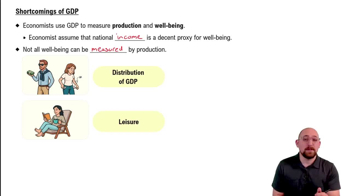
 02:21
02:21