Skip to main content
Macroeconomics
My Course
Learn
Exam Prep
AI Tutor
Study Guides
Flashcards
Explore
Try the app
My Course
Learn
Exam Prep
AI Tutor
Study Guides
Flashcards
Explore
Try the app
Back
Shifts in the Market for Loanable Funds definitions
You can tap to flip the card.
Loanable Funds
You can tap to flip the card.
👆
Loanable Funds
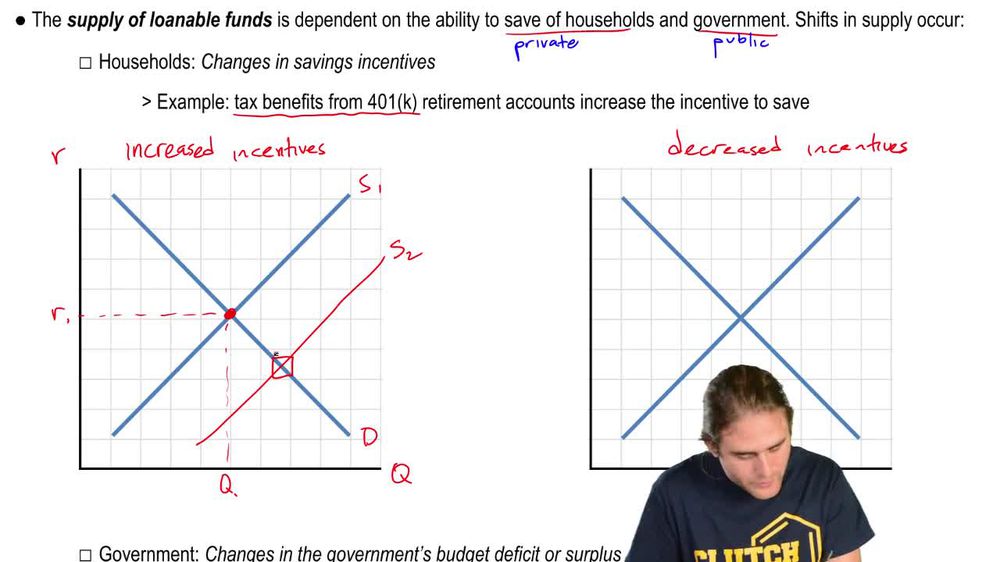
Financial resources available for borrowing, sourced from household and government savings, and allocated to firms and government for investment.
Track progress
Control buttons has been changed to "navigation" mode.
1/13
Related flashcards
Related practice
Recommended videos
Shifts in the Market for Loanable Funds quiz
Shifts in the Market for Loanable Funds
15 Terms
Shifts in the Market for Loanable Funds
13. The Financial System
10 problems
Topic
Stocks, Bonds, and Mutual Funds
13. The Financial System
10 problems
Topic
14. The Financial System - Part 1 of 2
8 topics
15 problems
Chapter
13. The Financial System - Part 2 of 2
1 topic
3 problems
Chapter
Guided course
06:56
Demand Shifts in the Market for Loanable Funds
2
views
Guided course
06:16
Supply Shifts in the Market for Loanable Funds
2
views
Terms in this set (13)
Hide definitions
Loanable Funds
Financial resources available for borrowing, sourced from household and government savings, and allocated to firms and government for investment.
Interest Rate
The price in the market for borrowing financial resources, determined by the intersection of supply and demand for funds.
Equilibrium
The point where the quantity of financial resources supplied equals the quantity demanded, setting the market price and amount exchanged.
Demand Curve
A graphical representation showing how much financial resources firms and government want to borrow at various prices.
Supply Curve
A graphical representation showing how much financial resources households and government are willing to provide at various prices.
Corporate Tax Rate
A government-imposed percentage on firms' profits, influencing their willingness to invest and borrow financial resources.
Budget Deficit
A situation where government spending exceeds tax revenue, leading to increased borrowing needs in the financial market.
Budget Surplus
A situation where government tax revenue exceeds spending, resulting in additional public savings and increased financial resource supply.
Private Savings
Financial resources set aside by households, forming a major component of the supply in the market for borrowing.
Public Savings
Financial resources retained by the government when tax revenue surpasses spending, contributing to the supply of funds.
Incentives for Savings
External motivators, such as tax benefits, that encourage households to set aside more financial resources for future use.
Future Profit Expectations
Firms' outlook on potential earnings, which influences their willingness to invest and borrow financial resources.
Quantity of Funds
The total amount of financial resources exchanged between savers and borrowers at a given market price.
 BackBack
 06:56
06:56