Skip to main content
Macroeconomics
My Course
Learn
Exam Prep
AI Tutor
Study Guides
Flashcards
Explore
Try the app
My Course
Learn
Exam Prep
AI Tutor
Study Guides
Flashcards
Explore
Try the app
Back
Savings Equal Investment quiz
You can tap to flip the card.
What is the key macroeconomic identity relating household savings and firm investment?
You can tap to flip the card.
👆
What is the key macroeconomic identity relating household savings and firm investment?
The key identity is that household savings equals investment by firms in the economy.
Track progress
Control buttons has been changed to "navigation" mode.
1/15
Related flashcards
Related practice
Recommended videos
Savings Equal Investment definitions
Savings Equal Investment
15 Terms
Savings Equal Investment
13. The Financial System
10 problems
Topic
Market for Loanable Funds
13. The Financial System
10 problems
Topic
14. The Financial System - Part 1 of 2
8 topics
15 problems
Chapter
13. The Financial System - Part 2 of 2
1 topic
3 problems
Chapter
Guided course
04:53
National Savings, Private Savings, and Public Savings
2
views
Guided course
07:48
Saving Equals Investment
2
views
Guided course
03:56
Savings Equals Investment in an Open Economy
5
views
Terms in this set (15)
Hide definitions
What is the key macroeconomic identity relating household savings and firm investment?
The key identity is that household savings equals investment by firms in the economy.
How is 'savings' defined in macroeconomics?
Savings is the portion of current income not consumed by households.
What does 'investment' mean in the context of macroeconomics?
Investment refers to resources devoted by firms to increase future output, such as factories and machinery.
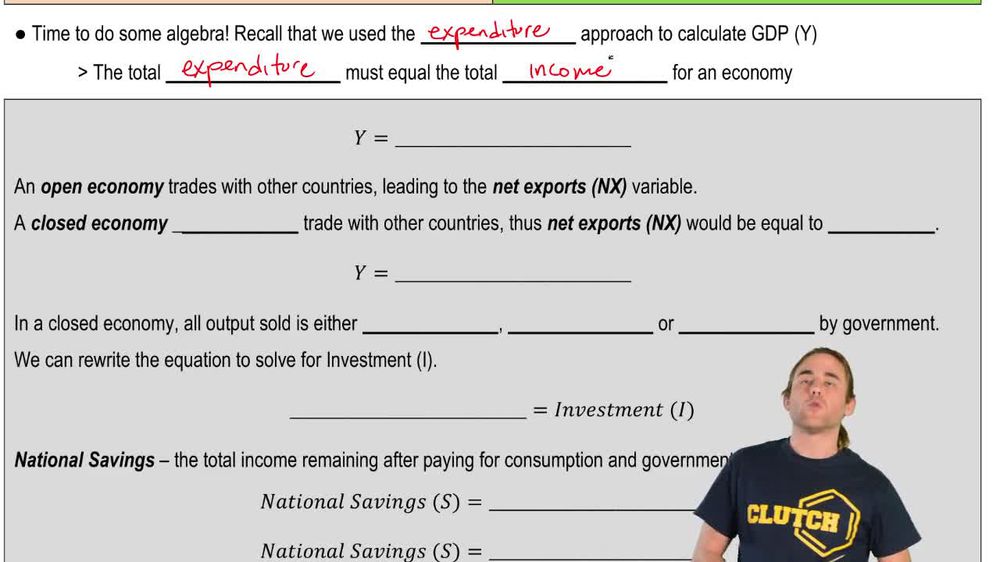
What is the expenditure approach formula for calculating GDP?
GDP (Y) is calculated as consumption (C) plus investment (I) plus government purchases (G) plus net exports (NX): Y = C + I + G + NX.
In a closed economy, what value does net exports (NX) take?
In a closed economy, net exports (NX) are zero because there is no trade with other countries.
How do you solve for investment (I) in a closed economy using the GDP equation?
Investment (I) equals GDP (Y) minus consumption (C) minus government purchases (G): I = Y - C - G.
What does the equation Y - C - G represent in a closed economy?
Y - C - G represents national savings, which is the total income left after consumption and government purchases.
How is national savings related to investment in a closed economy?
In a closed economy, national savings equals investment: National Savings = Investment.
How can national savings be broken down?
National savings can be divided into private savings (by households) and public savings (by the government).
How do you calculate private savings?
Private savings is calculated as income (Y) minus consumption (C) minus taxes (T): Private Savings = Y - C - T.
How do you calculate public savings?
Public savings is the government's tax revenue minus its spending: Public Savings = T - G.
What does a government budget surplus indicate?
A budget surplus means the government's tax revenue exceeds its spending, resulting in positive public savings.
What does a government budget deficit indicate?
A budget deficit means the government spends more than it collects in taxes, resulting in negative public savings.
How does the savings-investment identity change in an open economy?
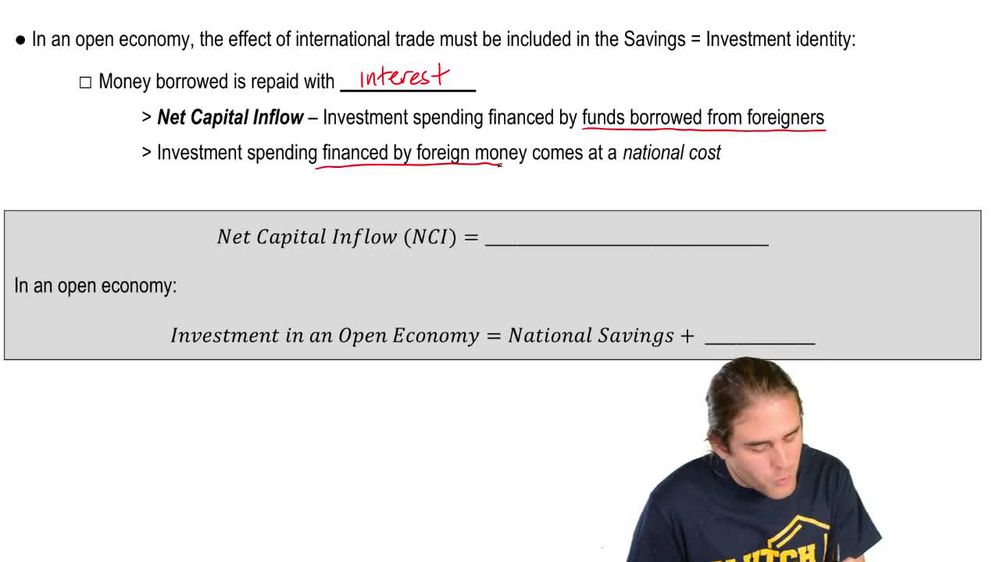
In an open economy, investment equals national savings plus net capital inflow (from net exports): Investment = National Savings + Net Capital Inflow.
What happens when a country imports more than it exports?
When imports exceed exports, the country experiences a net capital inflow, borrowing from abroad to finance domestic investment.
 BackBack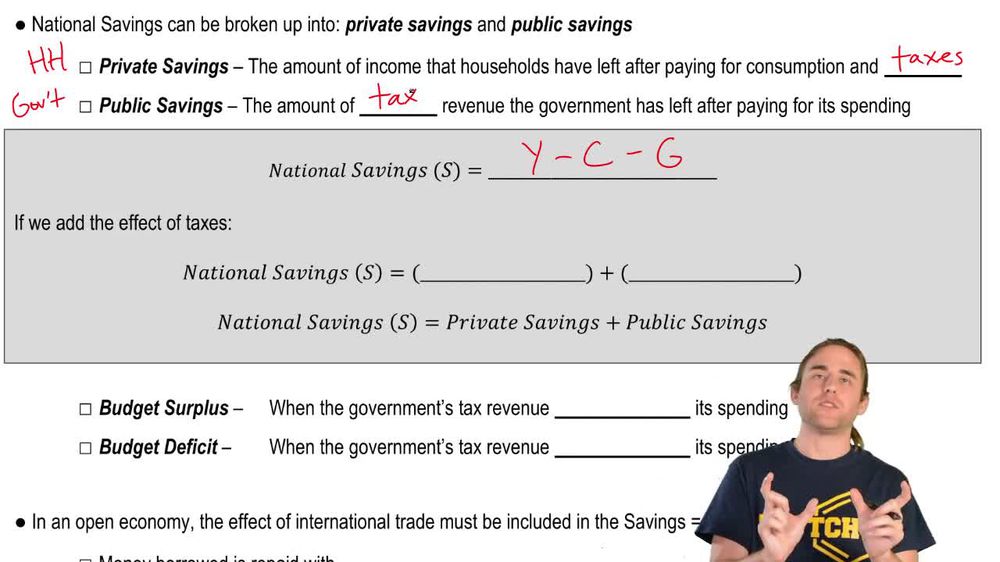
 04:53
04:53