Skip to main content
Macroeconomics
My Course
Learn
Exam Prep
AI Tutor
Study Guides
Flashcards
Explore
Try the app
My Course
Learn
Exam Prep
AI Tutor
Study Guides
Flashcards
Explore
Try the app
Back
Revenue in Monopolistic Competition definitions
You can tap to flip the card.
Monopolistic Competition
You can tap to flip the card.
👆
Monopolistic Competition
A market structure with many firms offering differentiated products and facing competition, but each has some pricing power.
Track progress
Control buttons has been changed to "navigation" mode.
1/15
Related flashcards
Recommended videos
Revenue in Monopolistic Competition quiz
Revenue in Monopolistic Competition
15 Terms
Guided course
03:28
Monopolistic Competition Revenue
Guided course
07:13
Monopolistic Competition Marginal Revenue
Terms in this set (15)
Hide definitions
Monopolistic Competition
A market structure with many firms offering differentiated products and facing competition, but each has some pricing power.
Demand Curve
A graphical representation showing the relationship between price and quantity demanded, typically downward sloping in this context.
Price Effect
The change in total revenue resulting from receiving less revenue per unit when price decreases.
Output Effect
The change in total revenue resulting from selling more units when price decreases.
Marginal Revenue
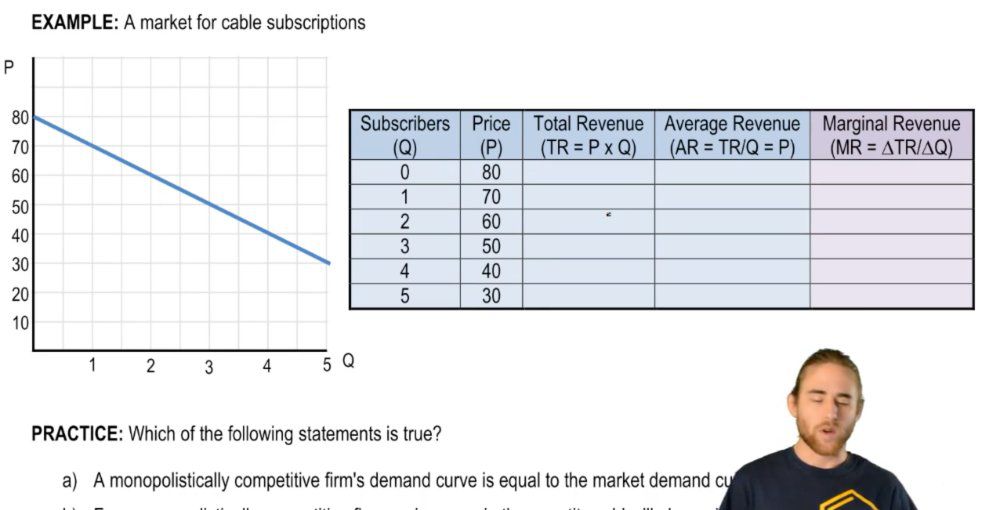
The additional revenue gained from selling one more unit, always less than price in this market structure.
Total Revenue
The overall income from sales, calculated as price multiplied by quantity sold.
Average Revenue
The revenue per unit sold, always equal to price and aligns with the demand curve.
Marginal Cost
The extra cost incurred from producing one additional unit, crucial for profit maximization.
Profit Maximization
The process where firms adjust output so that marginal revenue equals marginal cost.
Differentiation
The process by which firms make their products distinct from competitors, influencing consumer choice.
Negative Marginal Revenue
A situation where selling an additional unit decreases total revenue, often due to a significant price drop.
Perfect Competition
A market structure where many firms sell identical products and marginal revenue equals price.
Revenue Curve
A graphical depiction of how a firm's revenue changes with varying output levels.
Quantity Demanded
The total number of units consumers are willing to buy at a given price.
Market Structure
The organizational and competitive characteristics of a market, influencing firm behavior and pricing.
 BackBack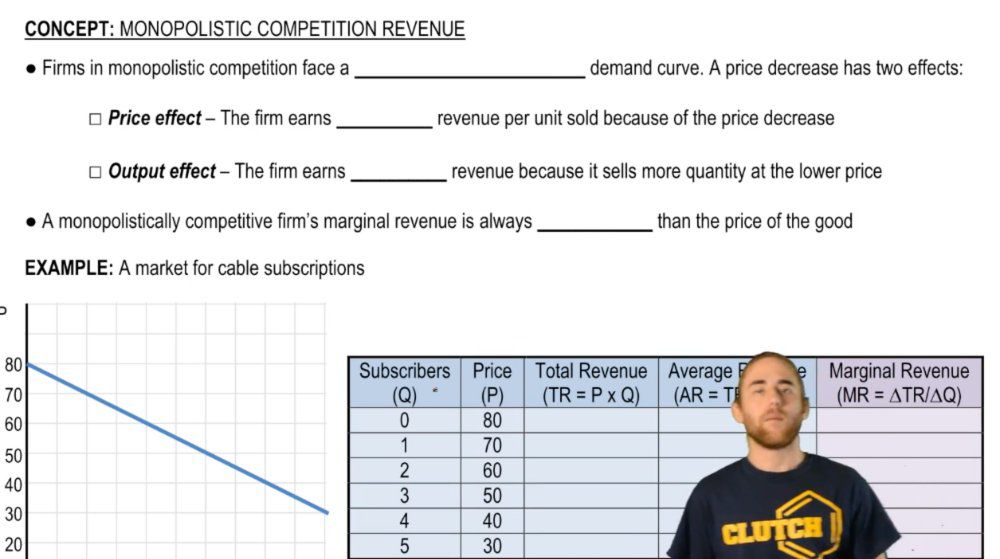
 03:28
03:28