Skip to main content
Macroeconomics
My Course
Learn
Exam Prep
AI Tutor
Study Guides
Flashcards
Explore
Try the app
My Course
Learn
Exam Prep
AI Tutor
Study Guides
Flashcards
Explore
Try the app
Back
Revenue, Cost, and Profit quiz
You can tap to flip the card.
How is total revenue calculated for a firm?
You can tap to flip the card.
👆
How is total revenue calculated for a firm?
Total revenue is calculated by multiplying the price per unit by the quantity of units sold.
Track progress
Control buttons has been changed to "navigation" mode.
1/15
Related flashcards
Recommended videos
Revenue, Cost, and Profit definitions
Revenue, Cost, and Profit
15 Terms
Guided course
01:59
Accounting Profit and Economic Profit
1
views
Guided course
05:51
Explicit and Implicit Cost
1
views
Guided course
07:54
Fixed Costs and Variable Costs; Short Run and Long Run
1
views
Terms in this set (15)
Hide definitions
How is total revenue calculated for a firm?
Total revenue is calculated by multiplying the price per unit by the quantity of units sold.
What is the difference between revenue and profit?
Revenue is the total money received from sales, while profit is what remains after subtracting costs from revenue.
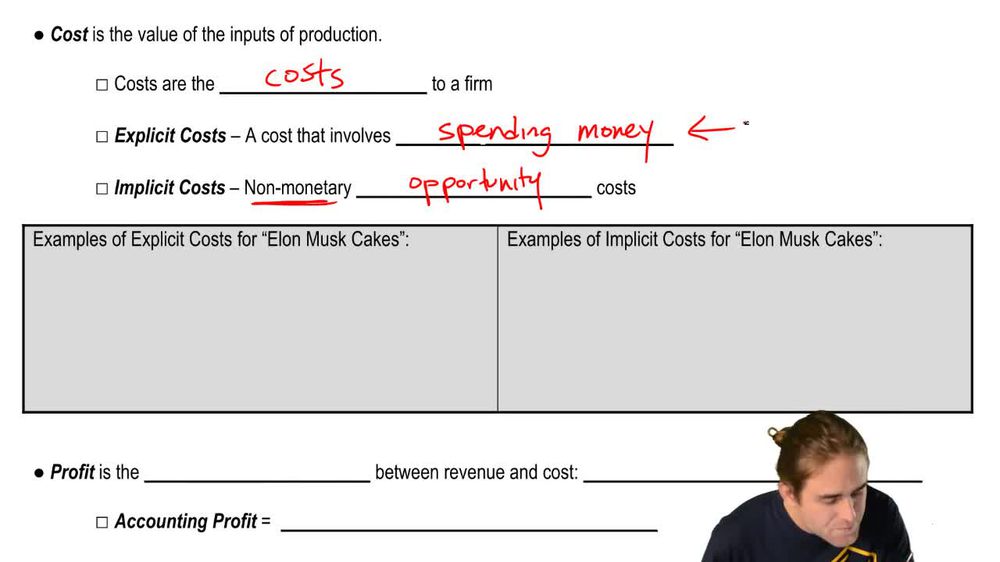
What is an explicit cost?
An explicit cost is a cost that involves a direct monetary payment, such as wages, rent, or materials.
What is an implicit cost?
An implicit cost is a non-monetary opportunity cost, such as foregone salary or interest, that does not involve a direct payment.
How do you calculate accounting profit?
Accounting profit is calculated as total revenue minus explicit costs.
How do you calculate economic profit?
Economic profit is calculated as total revenue minus both explicit and implicit costs.
Give an example of an explicit cost for a bakery.
Examples include paying for sugar, flour, employee wages, or rent for the bakery space.
Give an example of an implicit cost for a business owner.
An implicit cost could be the salary the owner gave up from a previous job or the interest lost by using savings to fund the business.
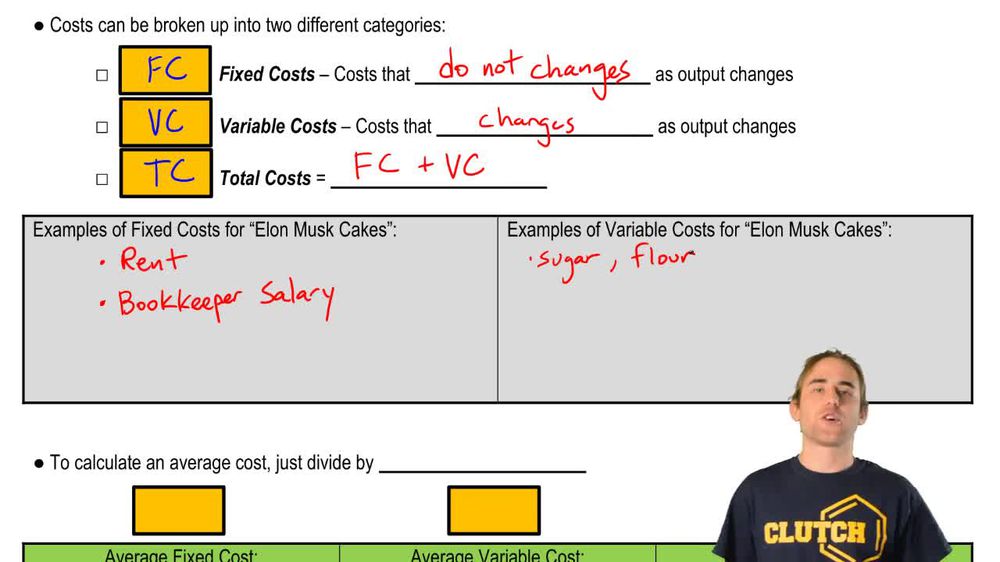
What is a fixed cost?
A fixed cost is a cost that does not change with the level of output, such as rent or a salaried employee's wage.
What is a variable cost?
A variable cost changes with the level of output, such as the cost of ingredients or hourly labor.
How do you calculate average fixed cost (AFC)?
Average fixed cost is calculated by dividing total fixed costs by the quantity of output produced.
How do you calculate average variable cost (AVC)?
Average variable cost is calculated by dividing total variable costs by the quantity of output produced.
How do you calculate average total cost (ATC)?
Average total cost is calculated by dividing total cost by quantity, or by adding average fixed cost and average variable cost.
What defines the short run in cost analysis?
The short run is a period in which at least one cost is fixed and cannot be changed.
What defines the long run in cost analysis?
The long run is a period in which all costs become variable, allowing the firm to adjust all inputs.
 BackBack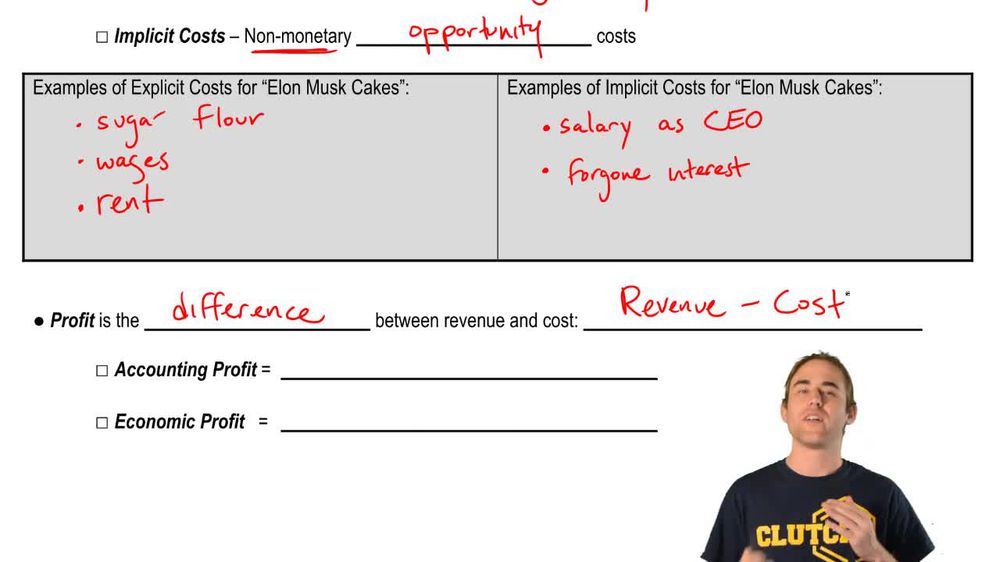
 01:59
01:59