Back

Quantitative Analysis of Consumer and Producer Surplus at Equilibrium quiz

Control buttons has been changed to "navigation" mode.
1/15
  • What is the first step in calculating consumer and producer surplus at equilibrium?

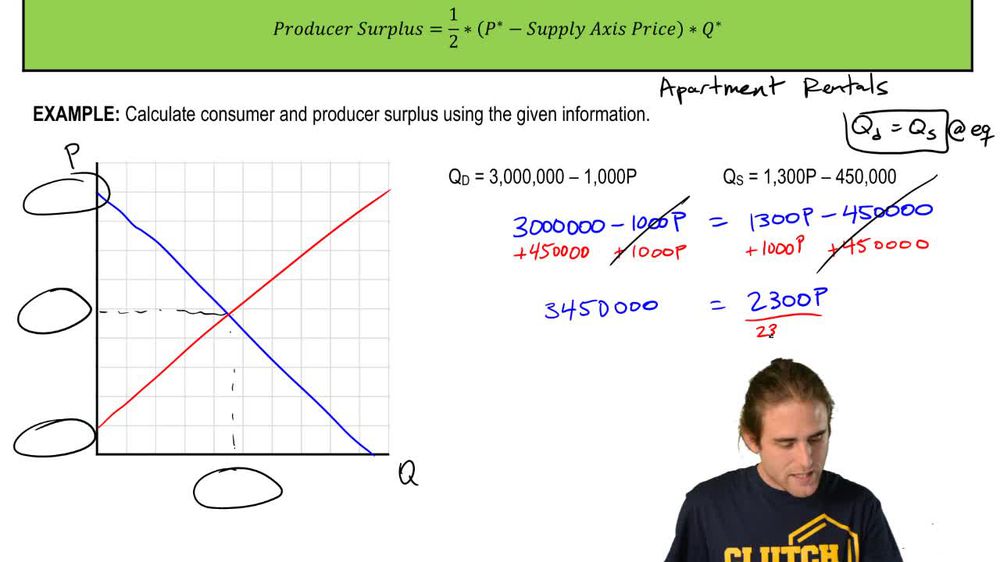
    The first step is to find the equilibrium price (P*) and equilibrium quantity (Q*) by setting quantity demanded equal to quantity supplied and solving algebraically.
  • How do you find the equilibrium price (P*) in a market using algebra?

    Set the quantity demanded equation equal to the quantity supplied equation and solve for the price variable.
  • What is the equilibrium price (P*) for the apartment rental market example in the video?

    The equilibrium price is \$1,500.
  • What is the equilibrium quantity (Q*) for the apartment rental market example?

    The equilibrium quantity is 1,500,000 units.
  • What is the 'axis price' as described in the video?

    The axis price is the price where either the demand or supply curve intersects the price axis, found by setting quantity demanded or supplied to zero.
  • How do you calculate the demand axis price?

    Set quantity demanded to zero in the demand equation and solve for price; in the example, this gives \$3,000.
  • How do you calculate the supply axis price?

    Set quantity supplied to zero in the supply equation and solve for price; in the example, this gives \$346.
  • What is the formula for consumer surplus using the triangle area method?

    Consumer surplus = 0.5 × (demand axis price − equilibrium price) × equilibrium quantity.
  • What is the calculated consumer surplus in the apartment rental market example?

    The consumer surplus is \$1,125,000,000.
  • What is the formula for producer surplus using the triangle area method?

    Producer surplus = 0.5 × (equilibrium price − supply axis price) × equilibrium quantity.
  • What is the calculated producer surplus in the apartment rental market example?

    The producer surplus is \$865,500,000.
  • Why is it important to find the axis prices when calculating surplus?

    Axis prices are needed to determine the base of the triangles representing consumer and producer surplus on the graph.
  • What does the area above the market price and below the demand curve represent?

    It represents the consumer surplus.
  • What does the area below the market price and above the supply curve represent?

    It represents the producer surplus.
  • Why do we use the equilibrium quantity (Q*) as the height in both surplus calculations?

    Because at equilibrium, the quantity demanded equals the quantity supplied, so Q* is the relevant quantity for both consumer and producer surplus triangles.