Skip to main content
Macroeconomics
My Course
Learn
Exam Prep
AI Tutor
Study Guides
Flashcards
Explore
Try the app
My Course
Learn
Exam Prep
AI Tutor
Study Guides
Flashcards
Explore
Try the app
Back
Public Goods: Demand Curve and Optimal Quantity quiz
You can tap to flip the card.
How is the market demand curve for a private good constructed?
You can tap to flip the card.
👆
How is the market demand curve for a private good constructed?
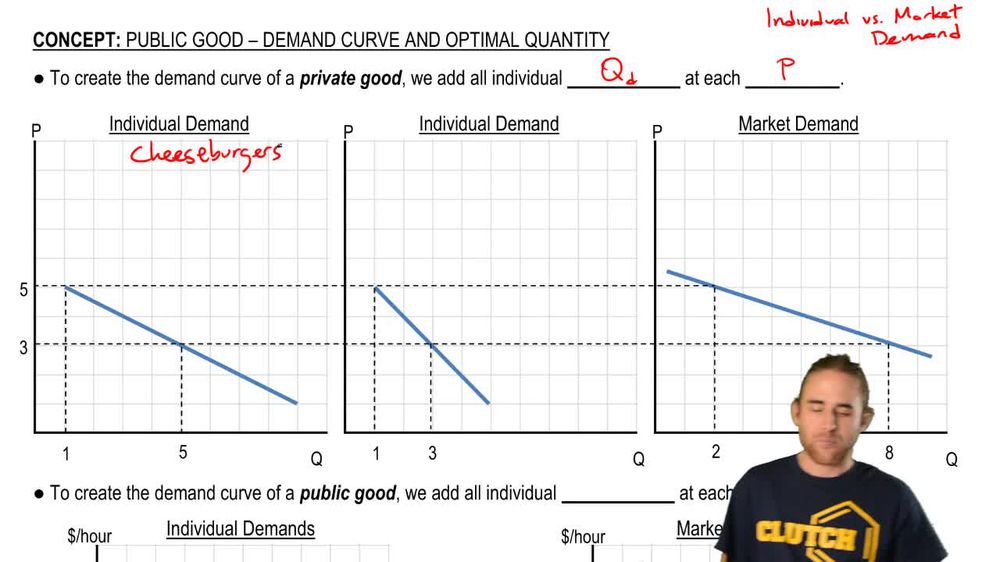
It is constructed by horizontally adding the individual quantities demanded at each price point.
Track progress
Control buttons has been changed to "navigation" mode.
1/15
Related flashcards
Related practice
Recommended videos
Public Goods: Demand Curve and Optimal Quantity definitions
Public Goods: Demand Curve and Optimal Quantity
13 Terms
Public Goods: Demand Curve and Optimal Quantity
8. The Types of Goods
10 problems
Topic
The Free Rider Problem and the Tragedy of the Commons
8. The Types of Goods
10 problems
Topic
8. The Types of Goods
3 topics
15 problems
Chapter
Guided course
08:18
Demand Curve of a Public Good
7
views
Guided course
03:52
Demand Curve of a Private Good
4
views
Terms in this set (15)
Hide definitions
How is the market demand curve for a private good constructed?
It is constructed by horizontally adding the individual quantities demanded at each price point.
What is the key difference in constructing the demand curve for a public good compared to a private good?
For public goods, individual prices are added vertically at each quantity, rather than adding quantities horizontally at each price.
What are the two main characteristics of public goods?
Public goods are non-rival and non-excludable.
In the cheeseburger example, how is market demand calculated at a price of \$3?
Person 1 demands 5 cheeseburgers and person 2 demands 3, so the market demand is 8 cheeseburgers.
Why do we add prices vertically for public goods?
Because everyone can use the same quantity, so the total societal value is the sum of what each individual is willing to pay for that quantity.
What is an example of a public good given in the transcript?
A security guard service shared by Jane's Restaurant and Bob's Auto Shop.
How do Jane and Bob determine the total value of 10 hours of security guard service?
Jane is willing to pay \$8 per hour and Bob \$10 per hour, so together they value it at \$18 per hour.
What does 'adding vertically' mean in the context of public goods?
It means summing the prices each individual is willing to pay for each unit of the good at a given quantity.
How is the optimal quantity of a public good determined?
It is where the marginal social benefit (MSB) equals the marginal social cost (MSC).
What does the marginal social benefit (MSB) curve represent for public goods?
It represents the sum of the individual values (prices) consumers place on the public good at each quantity.
What is the marginal social cost (MSC) curve typically equal to in the absence of externalities?
It is equal to the supply curve.
At what point is the optimal quantity of a public good provided?
At the quantity where the MSB curve intersects the MSC (supply) curve.
Why might the supply curve for a public good be adjusted?
It would be adjusted if there are externalities, to account for all societal costs.
What is the process for constructing the MSB curve for a public good?
Sum the individual prices each consumer is willing to pay for each unit of the public good at each quantity.
How does the demand curve for a private good differ from that of a public good in terms of aggregation?
Private goods aggregate quantities horizontally at each price, while public goods aggregate prices vertically at each quantity.
 BackBack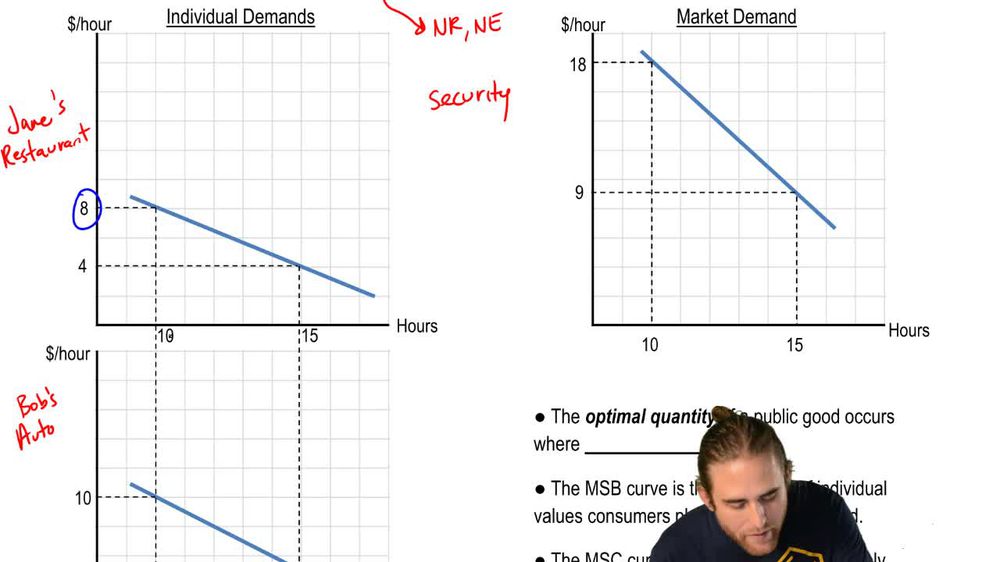
 08:18
08:18