Back

Willingness to Sell and Producer Surplus definitions

Control buttons has been changed to "navigation" mode.
1/13
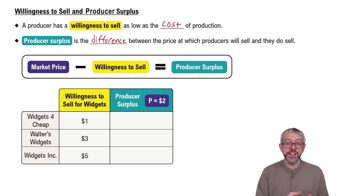
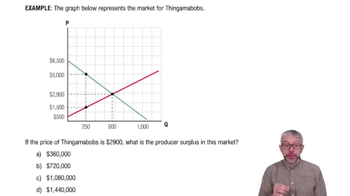
  • Producer Surplus

    Extra benefit received when selling at a market price above the minimum acceptable price, visually shown as the area above the supply curve and below market price.
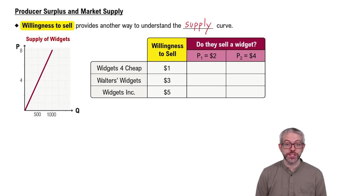
  • Willingness to Sell

    Lowest price at which a seller is prepared to offer a product, typically equal to or above production cost.
  • Market Price

    Prevailing price at which goods are actually exchanged between buyers and sellers in a market.
  • Supply Curve

    Graphical representation showing the relationship between price levels and quantities that producers are prepared to offer.
  • Cost of Production

    Total expense incurred by a business to manufacture a product, setting the lower bound for acceptable selling price.
  • Consumer Surplus

    Benefit buyers receive when they pay less than their maximum willingness to pay, represented by the area below demand and above price.
  • Base

    Horizontal distance on a graph, often representing the quantity of goods sold, used in calculating areas like surplus.
  • Height

    Vertical distance on a graph, often representing the difference between two price levels, used in area calculations.
  • Area

    Space between two curves or lines on a graph, used to visually represent economic concepts like surplus.
  • Triangle Formula

    Mathematical method, one half base times height, used to calculate the area representing total surplus on a graph.
  • Quantity

    Number of units of a good offered or sold in a market, often shown on the horizontal axis of a supply graph.
  • Price Level

    Specific value on the vertical axis of a graph indicating the amount buyers pay or sellers receive per unit.
  • Market Exit

    Situation where sellers choose not to participate because the market price falls below their minimum acceptable price.