Skip to main content
Macroeconomics
My Course
Learn
Exam Prep
AI Tutor
Study Guides
Flashcards
Explore
Try the app
My Course
Learn
Exam Prep
AI Tutor
Study Guides
Flashcards
Explore
Try the app
Back
Price Elasticity of Supply definitions
You can tap to flip the card.
Price Elasticity of Supply
You can tap to flip the card.
👆
Price Elasticity of Supply
A measure of how much quantity supplied changes in response to a change in price, always yielding a positive value due to the law of supply.
Track progress
Control buttons has been changed to "navigation" mode.
1/13
Related flashcards
Related practice
Recommended videos
Price Elasticity of Supply quiz
Price Elasticity of Supply
15 Terms
Price Elasticity of Supply
4. Elasticity
5 problems
Topic
Price Elasticity of Supply on a Graph
4. Elasticity
10 problems
Topic
4. Elasticity - Part 1 of 2
10 topics
15 problems
Chapter
4. Elasticity - Part 2 of 2
1 topic
3 problems
Chapter
Guided course
05:38
Price Elasticity of Supply
16
views
Terms in this set (13)
Hide definitions
Price Elasticity of Supply
A measure of how much quantity supplied changes in response to a change in price, always yielding a positive value due to the law of supply.
Quantity Supplied
The amount of a good producers are willing to offer for sale at a specific price, used in elasticity calculations.
Law of Supply
The principle stating that as price increases, the quantity supplied also increases, resulting in a positive relationship.
Midpoint Method
A calculation technique using averages to determine percentage changes, ensuring consistent elasticity results.
Percentage Change
A value found by dividing the difference between two numbers by their average, used to compare changes in price and quantity.
Inelastic Supply
A situation where the percentage change in quantity supplied is less than the percentage change in price, resulting in a value less than one.
Elastic Supply
A condition where the percentage change in quantity supplied exceeds the percentage change in price, giving a value greater than one.
Unit Elastic Supply
A scenario where the percentage change in quantity supplied equals the percentage change in price, resulting in a value of one.
Numerator
The top part of a fraction in the elasticity formula, representing the percentage change in quantity supplied.
Denominator
The bottom part of a fraction in the elasticity formula, representing the percentage change in price.
Supply Curve
A graphical representation showing the relationship between price and quantity supplied for a good.
Calculation Steps
A sequence involving subtraction, addition, averaging, and division to determine elasticity values.
Positive Value
A result always obtained in supply elasticity calculations due to both price and quantity supplied moving in the same direction.
 BackBack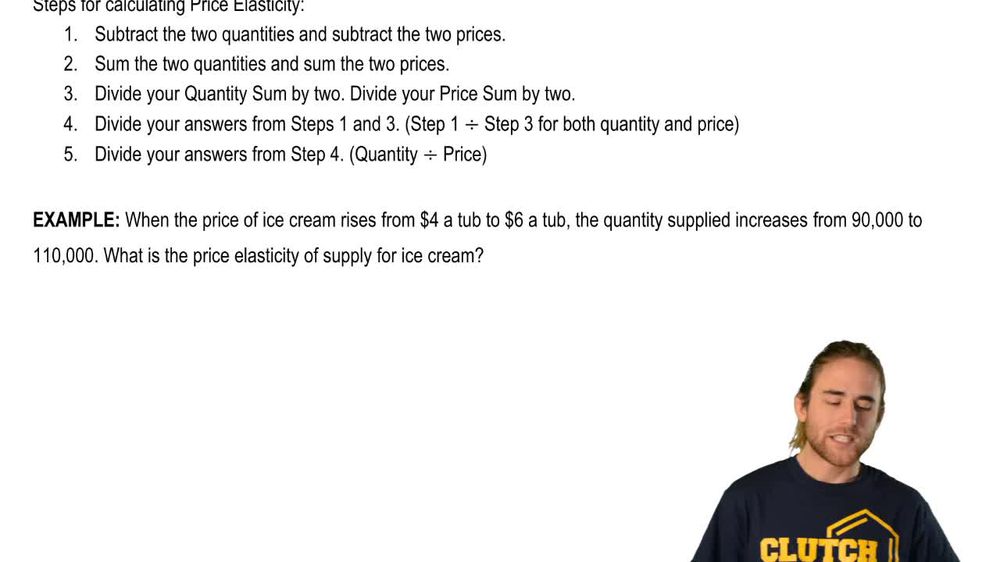
 05:38
05:38