Skip to main content
Macroeconomics
My Course
Learn
Exam Prep
AI Tutor
Study Guides
Flashcards
Explore
Try the app
My Course
Learn
Exam Prep
AI Tutor
Study Guides
Flashcards
Explore
Try the app
Back
PPF - Price of the Trade quiz
You can tap to flip the card.
What condition must the trade price meet for trade to be mutually beneficial?
You can tap to flip the card.
👆
What condition must the trade price meet for trade to be mutually beneficial?
The trade price must lie between the opportunity costs of the two trading partners.
Track progress
Control buttons has been changed to "navigation" mode.
1/15
Related flashcards
Related practice
Recommended videos
PPF - Price of the Trade definitions
PPF - Price of the Trade
13 Terms
PPF - Price of the Trade
2. Introductory Economic Models
10 problems
Topic
PPF - Comparative Advantage and Trade
2. Introductory Economic Models
10 problems
Topic
2. Introductory Economic Models
6 topics
15 problems
Chapter
Guided course
03:47
The Price of the Trade
9
views
Terms in this set (15)
Hide definitions
What condition must the trade price meet for trade to be mutually beneficial?
The trade price must lie between the opportunity costs of the two trading partners.
Why wouldn't a trade price set at one party's opportunity cost be beneficial to both parties?
Because the other party could achieve that outcome on their own and would have no incentive to trade.
If the opportunity costs are 1 and 2 hunch punches per pizza roll, what is a fair trade price?
A fair trade price would be any value between 1 and 2 hunch punches per pizza roll, such as 1.5.
What happens if the trade price is set outside the range of opportunity costs?
The trade will not be mutually beneficial, and at least one party will not want to trade.
How does supply and demand affect the final trade price?
If one good is more abundant, its value decreases, which can shift the trade price within the opportunity cost range.
What role does negotiating power play in determining the trade price?
A party with stronger negotiating power may secure a trade price more favorable to themselves within the acceptable range.
Why might a trade price be set exactly in the middle of the opportunity cost range?
Setting the price in the middle is often seen as fair and equitable for both parties.
What is the opportunity cost range for trading pizza rolls for hunch punch if the costs are 1 and 2 hunch punches per pizza roll?
The range is between 1 and 2 hunch punches per pizza roll.
If trading hunch punch for pizza rolls, what is the acceptable price range if the opportunity costs are 0.5 and 1 pizza roll per hunch punch?
The acceptable price range is between 0.5 and 1 pizza roll per hunch punch.
What is the main reason both parties benefit from a trade within the opportunity cost range?
Both parties receive more than they could produce on their own, making the trade advantageous.
How can equity influence the final trade price?
Parties may aim for an equitable trade to ensure both are better off, possibly choosing a price in the middle of the range.
What would happen if the trade price was set at 2 hunch punches per pizza roll when one party's opportunity cost is also 2?
That party would not benefit from the trade and would have no reason to participate.
Why is it important to know each party's opportunity cost before setting a trade price?
Knowing the opportunity costs ensures the trade price is set within a range that benefits both parties.
What could cause the trade price to be closer to one party's opportunity cost than the other's?
Factors like negotiating power or differences in supply and demand can shift the price closer to one party's opportunity cost.
What is the result if both parties can achieve the trade price on their own without trading?
There is no incentive to trade, so the trade will not occur.
 BackBack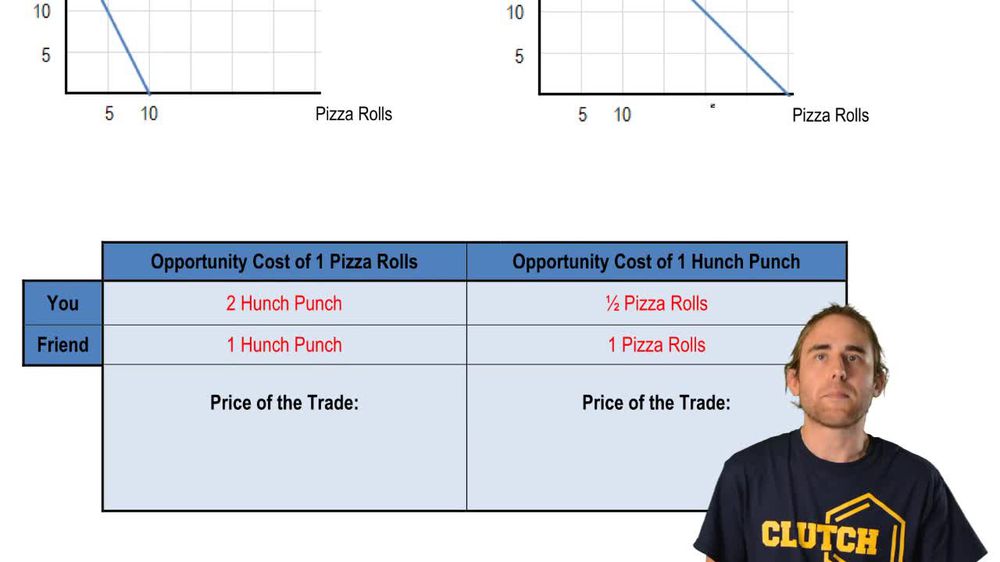
 03:47
03:47