The poverty line is a level of income set by the government that defines the threshold below which families are considered poor.
How does household size affect the poverty line?
The poverty line increases with household size; larger households have a higher poverty threshold.
What was the poverty line for a four-person household in the US in 2017?
In 2017, the poverty line for a four-person household in the US was \$24,300.
How is the poverty rate defined?
The poverty rate is the percentage of the population living below the poverty line.
What are in-kind transfers, and are they included in poverty calculations?
In-kind transfers are non-cash benefits like food stamps or healthcare, and they are not included in poverty calculations.
Which racial groups are more likely to live in poverty in the US?
Blacks and Hispanics are about three times more likely to live in poverty than whites.
How does age correlate with poverty?
Children are more likely to be members of poor families than the elderly.
How does family composition affect the likelihood of poverty?
Families headed by a single female are five times more likely to live in poverty.
What is the poverty trap?
The poverty trap refers to mechanisms that make it difficult for poor people to escape poverty, causing poverty to be self-reinforcing.
How do credit constraints contribute to the poverty trap?
Credit constraints make it hard for poor people to get loans, limiting their ability to invest in opportunities that could help them escape poverty.
Why do poor neighborhoods often have underfunded schools?
Poor neighborhoods usually have lower funding for schools, which leads to lower quality education for children living there.
What is human capital and how does poverty affect its development?
Human capital is the education and training that increases productivity and wages; poverty limits access to quality education, reducing human capital development.
How does the poverty trap affect future generations?
Children born into poverty often attend underfunded schools, leading to lower education and perpetuating poverty into the next generation.
Why are in-kind transfers considered a form of income even though they are not counted in poverty statistics?
In-kind transfers provide goods and services that families would otherwise have to pay for, effectively increasing their resources.
How does understanding poverty help in analyzing economic inequality and fiscal policy?
Understanding poverty helps analyze economic inequality, labor productivity, and the effects of fiscal policy on aggregate demand and social welfare.
 Back
Back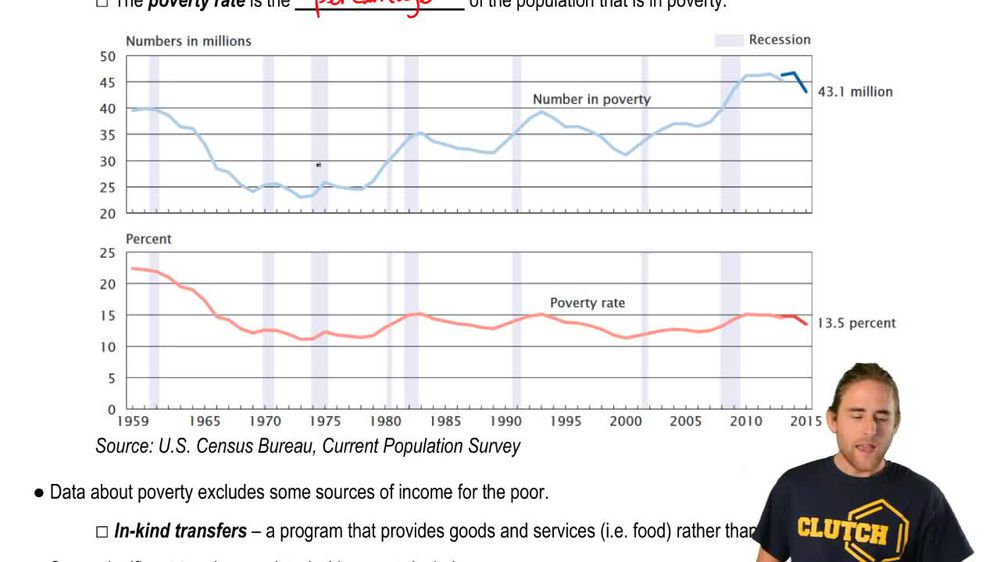
 05:02
05:02