Skip to main content
Macroeconomics
My Course
Learn
Exam Prep
AI Tutor
Study Guides
Flashcards
Explore
Try the app
My Course
Learn
Exam Prep
AI Tutor
Study Guides
Flashcards
Explore
Try the app
Back
Polices to Reduce Poverty definitions
You can tap to flip the card.
Minimum Wage Laws
You can tap to flip the card.
👆
Minimum Wage Laws
Government-set pay floors ensuring workers receive at least a specified hourly income, often aimed at boosting earnings for low-income individuals.
Track progress
Control buttons has been changed to "navigation" mode.
1/14
Related flashcards
Recommended videos
Polices to Reduce Poverty quiz
Polices to Reduce Poverty
15 Terms
Guided course
06:15
Policies to Reduce Poverty
Terms in this set (14)
Hide definitions
Minimum Wage Laws
Government-set pay floors ensuring workers receive at least a specified hourly income, often aimed at boosting earnings for low-income individuals.
Price Floor
A mandated lower limit on prices, preventing transactions below a certain level, commonly used to set minimum wages.
Welfare
Government program providing cash payments to individuals in financial need, typically with eligibility restrictions.
Negative Income Tax
A system where low-income earners receive payments from the government instead of paying taxes, effectively subsidizing their income.
Subsidy
Financial assistance from the government to support individuals or groups, often reducing the burden of poverty.
Earned Income Tax Credit
A U.S. tax benefit functioning similarly to a negative income tax, offering refunds to low-income workers.
In-Kind Transfers
Non-cash benefits provided by the government, such as food vouchers or health care services, to support those in need.
Food Stamps
Government-issued vouchers allowing recipients to purchase food, enhancing access to nutrition for low-income households.
Medicaid
A public health insurance program offering free or low-cost medical services to individuals with limited income.
Incentive to Work
The motivation for individuals to seek employment, which can be affected by the structure of government assistance programs.
Economic Efficiency
Optimal allocation of resources where no one can be made better off without making someone else worse off, potentially impacted by welfare policies.
Aggregate Demand Management
Government efforts to influence total spending in the economy, often through fiscal policy, to achieve economic objectives.
Fiscal Policy
Government decisions on taxation and spending designed to influence economic activity and address issues like poverty.
Standard of Living
The level of material well-being and access to goods and services experienced by individuals or households.
 BackBack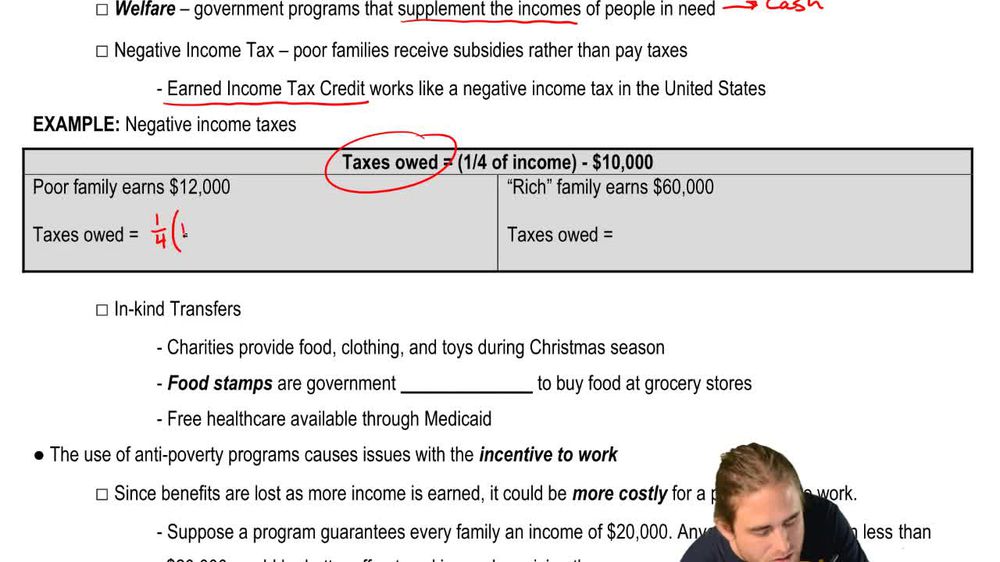
 06:15
06:15