Skip to main content
Macroeconomics
My Course
Learn
Exam Prep
AI Tutor
Study Guides
Flashcards
Explore
Try the app
My Course
Learn
Exam Prep
AI Tutor
Study Guides
Flashcards
Explore
Try the app
Back
Phillips Curve and Supply Shocks definitions
You can tap to flip the card.
Supply Shock
You can tap to flip the card.
👆
Supply Shock
An unexpected event causing sudden changes in production costs, often leading to shifts in aggregate supply and economic instability.
Track progress
Control buttons has been changed to "navigation" mode.
1/14
Related flashcards
Related practice
Recommended videos
Phillips Curve and Supply Shocks quiz #1
Phillips Curve and Supply Shocks
10 Terms
Phillips Curve and Supply Shocks
20. Tradeoffs Between Inflation and Unemployment
10 problems
Topic
Sacrifice Ratio
20. Tradeoffs Between Inflation and Unemployment
10 problems
Topic
21. Revisiting Inflation, Unemployment, and Policy
6 topics
15 problems
Chapter
Guided course
05:19
Shifting the Phillips Curve: Supply Shocks
2
views
Terms in this set (14)
Hide definitions
Supply Shock
An unexpected event causing sudden changes in production costs, often leading to shifts in aggregate supply and economic instability.
Short Run Aggregate Supply
A curve showing the relationship between total output and price level, influenced by input costs and subject to sudden shifts.
Input Prices
The costs of resources used by firms, such as gasoline, which directly affect production expenses and supply decisions.
GDP
A measure of total economic output, reflecting the value of all goods and services produced within a country.
Price Level
An index reflecting the average prices of goods and services in an economy, used to gauge inflation.
Inflation
A sustained increase in the general price level, reducing purchasing power and often linked to supply shocks.
Unemployment
The condition where individuals willing and able to work are unable to find jobs, often rising when output falls.
Phillips Curve
A graphical representation showing the inverse relationship between inflation and unemployment in the short run.
Short Run Phillips Curve
A curve illustrating the trade-off between inflation and unemployment, which can shift due to supply shocks.
Equilibrium
A state where economic forces such as supply and demand are balanced, determining output and price levels.
Trade-off
A situation where achieving lower unemployment may result in higher inflation, and vice versa, especially after shocks.
Policy Makers
Individuals or groups responsible for designing strategies to address economic challenges like inflation and unemployment.
Aggregate Supply
The total quantity of goods and services that producers are willing and able to supply at different price levels.
Double Jeopardy
A scenario where the economy faces both rising inflation and unemployment simultaneously, complicating policy responses.
 BackBack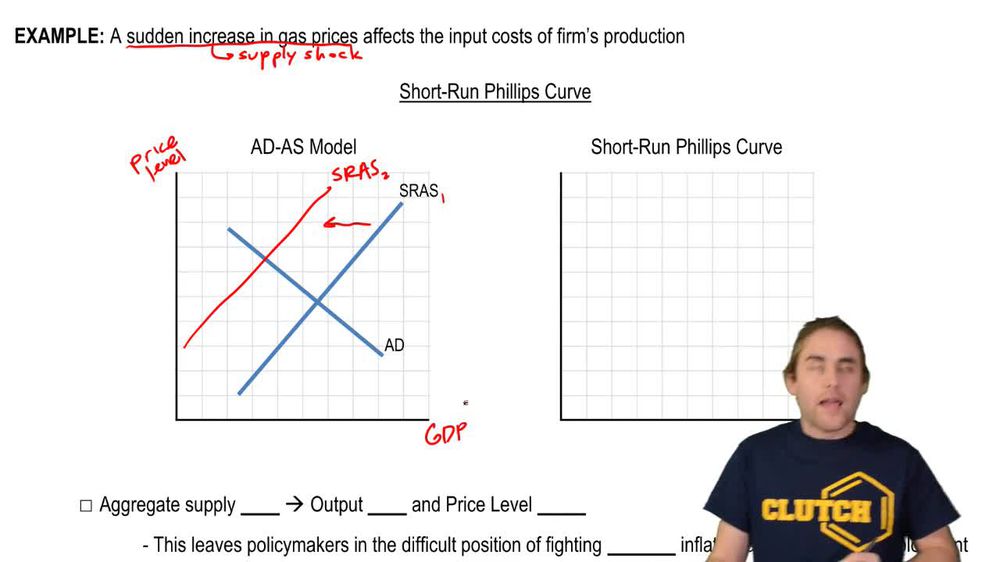
 05:19
05:19