Skip to main content
Macroeconomics
My Course
Learn
Exam Prep
AI Tutor
Study Guides
Flashcards
Explore
Try the app
My Course
Learn
Exam Prep
AI Tutor
Study Guides
Flashcards
Explore
Try the app
Back
Phillips Curve and Expected Inflation definitions
You can tap to flip the card.
Phillips Curve
You can tap to flip the card.
👆
Phillips Curve
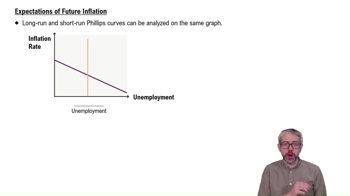
A graphical representation showing the relationship between inflation and unemployment, with distinct short run and long run interpretations.
Track progress
Control buttons has been changed to "navigation" mode.
1/15
Related flashcards
Related practice
Recommended videos
Phillips Curve and Expected Inflation quiz
Phillips Curve and Expected Inflation
15 Terms
Phillips Curve and Expected Inflation
20. Tradeoffs Between Inflation and Unemployment
10 problems
Topic
Phillips Curve and Supply Shocks
20. Tradeoffs Between Inflation and Unemployment
10 problems
Topic
21. Revisiting Inflation, Unemployment, and Policy
6 topics
15 problems
Chapter
07:46
Shifting the Phillip's Curve
09:52
Expectations of Future Inflation
Terms in this set (15)
Hide definitions
Phillips Curve
A graphical representation showing the relationship between inflation and unemployment, with distinct short run and long run interpretations.
Short Run Phillips Curve
A curve illustrating an inverse relationship between inflation and unemployment, influenced by differences between actual and expected inflation.
Long Run Phillips Curve
A vertical line on a graph indicating that, over time, inflation does not affect the natural rate of unemployment.
Expected Inflation
The rate of price increase that consumers and firms anticipate, shaping wage agreements and economic decisions.
Actual Inflation
The observed rate at which prices rise in the economy, which may differ from what was previously anticipated.
Nominal Wage
The dollar amount paid to workers, not adjusted for changes in the price level or purchasing power.
Real Wage
The purchasing power of income earned by workers, reflecting how much goods and services can be bought.
Natural Rate of Unemployment
The baseline level of joblessness in an economy, unaffected by the inflation rate in the long run.
Rational Expectations Theory
An economic idea stating that individuals use all available information to forecast future economic variables.
Trade Off
A situation where achieving lower unemployment comes at the cost of higher inflation, or vice versa, in the short run.
Equilibrium
A point where actual inflation matches expected inflation, causing short run and long run Phillips curves to intersect.
Purchasing Power
The amount of goods and services that can be bought with a given amount of income, affected by inflation.
Curve Shift
A movement of the entire Phillips curve, typically caused by changes in expected inflation.
Profit
The financial gain firms experience when costs, such as real wages, decrease relative to product prices.
Labor
The workforce available to firms, whose cost is perceived differently depending on the relationship between actual and expected inflation.
 BackBack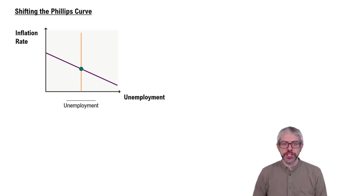
 07:46
07:46