It measures how much the quantity demanded of a product changes as a result of a change in the price of that same product.
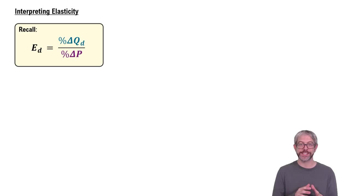
What is the formula for price elasticity of demand?
It is the percentage change in quantity demanded divided by the percentage change in price.
Why do economists use the absolute value when calculating price elasticity of demand?
Because the result is always negative due to the law of demand, and economists prefer to compare elasticities as positive numbers.
What does it mean if the price elasticity of demand is greater than one?
It means demand is elastic, so consumers are very sensitive to price changes.
What does it mean if the price elasticity of demand is less than one?
It means demand is inelastic, so consumers are not very sensitive to price changes.
What is unit elastic demand?
Unit elastic demand occurs when the price elasticity of demand equals one, meaning the percentage change in quantity demanded equals the percentage change in price.
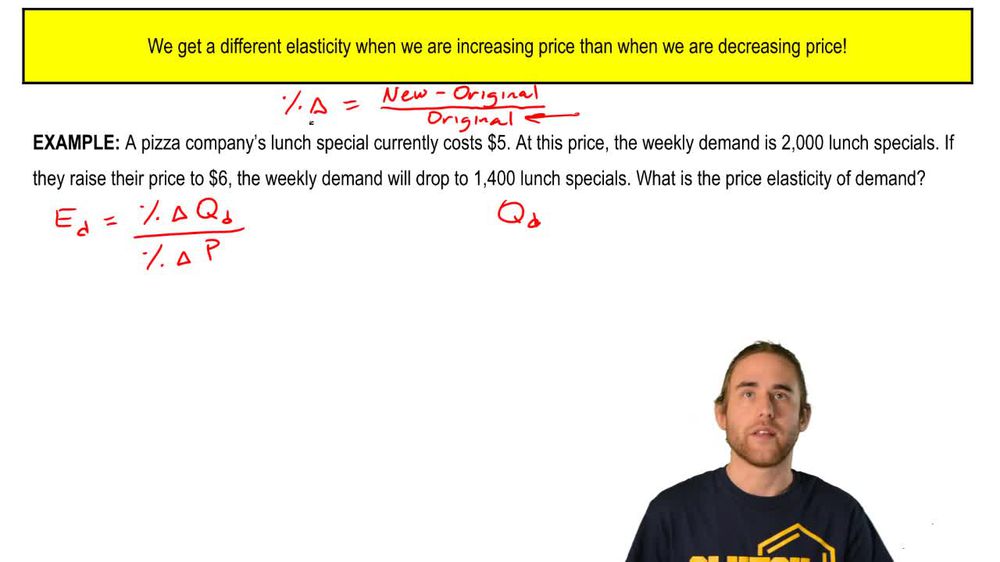
How do you calculate percentage change using the original value?
You subtract the original value from the new value and divide by the original value.
Why can using the original value in the denominator cause problems in elasticity calculations?
Because it gives different elasticity results depending on whether the price is increasing or decreasing, even with the same numbers.
What is the solution to the inconsistency caused by using the original value in elasticity calculations?
The solution is to use the average of the original and new values in the denominator for a more consistent calculation.
In the pizza example, what was the elasticity when the price increased from \$5 to \$6?
The price elasticity of demand was calculated as 1.5, indicating elastic demand.
In the pizza example, what was the elasticity when the price decreased from \$6 to \$5?
The price elasticity of demand was calculated as 2.569, which is even more elastic than the first scenario.
What does it mean if a product has elastic demand?
It means that a small change in taking price leads to a large change in quantity demanded.
Give an example of a product with inelastic demand.
Gasoline is an example, as people buy about the same amount even if the price rises.
Why are elasticities considered unitless?
Because they are ratios of percentage changes, so the units cancel out.
What is the main advantage of using the average value in the denominator when calculating elasticity?
It ensures that the calculated elasticity is consistent regardless of the direction of the price change.
 Back
Back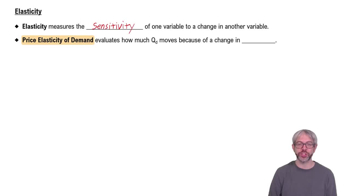
 03:33
03:33