Skip to main content
Macroeconomics
My Course
Learn
Exam Prep
AI Tutor
Study Guides
Flashcards
Explore
Try the app
My Course
Learn
Exam Prep
AI Tutor
Study Guides
Flashcards
Explore
Try the app
Back
Other Factors of Production: Land and Capital definitions
You can tap to flip the card.
Land
You can tap to flip the card.
👆
Land
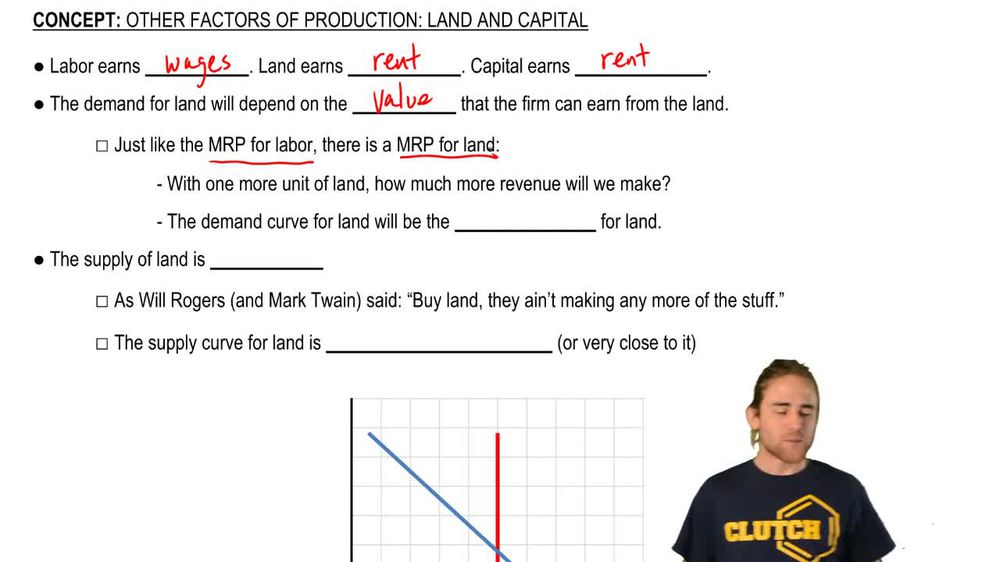
Physical terrain and natural resources, such as forests and oil, used in production and earning income through rent.
Track progress
Control buttons has been changed to "navigation" mode.
1/15
Related flashcards
Recommended videos
Other Factors of Production: Land and Capital quiz
Other Factors of Production: Land and Capital
15 Terms
Guided course
02:08
Other Factors of Production: Capital
Guided course
03:31
Other Factors of Production: Land
Terms in this set (15)
Hide definitions
Land
Physical terrain and natural resources, such as forests and oil, used in production and earning income through rent.
Capital
Physical assets like factories and equipment utilized to produce goods and services, generating income via rent.
Rent
Income received from providing land or capital for productive use, determined by market equilibrium.
Marginal Revenue Product
Additional revenue generated by employing one more unit of a factor, guiding demand for land and capital.
Supply Curve
Graphical representation showing the relationship between price and quantity offered for land or capital.
Demand Curve
Graph depicting the relationship between the price of a factor and the quantity firms wish to employ.
Perfectly Inelastic Supply
Situation where quantity remains unchanged regardless of price, illustrated by a vertical supply curve for land.
Upward Sloping Supply
Condition where higher prices lead to increased quantity supplied, typical for capital in markets.
Equilibrium
Market state where the quantity supplied equals the quantity demanded, setting the rental rate for factors.
Rental Rate
Market price paid for the use of land or capital, established at the intersection of supply and demand.
Production Function
Mathematical relationship showing output produced from varying amounts of inputs like land and capital.
Diminishing Marginal Productivity
Phenomenon where each additional unit of input yields less extra output than the previous one.
Physical Capital
Tangible assets such as machinery and buildings, distinct from human skills, used in production.
Natural Resources
Raw materials found in nature, including minerals and forests, classified under land in production.
Quantity
Fixed amount for land or variable for capital, representing the total units available or supplied in the market.
 BackBack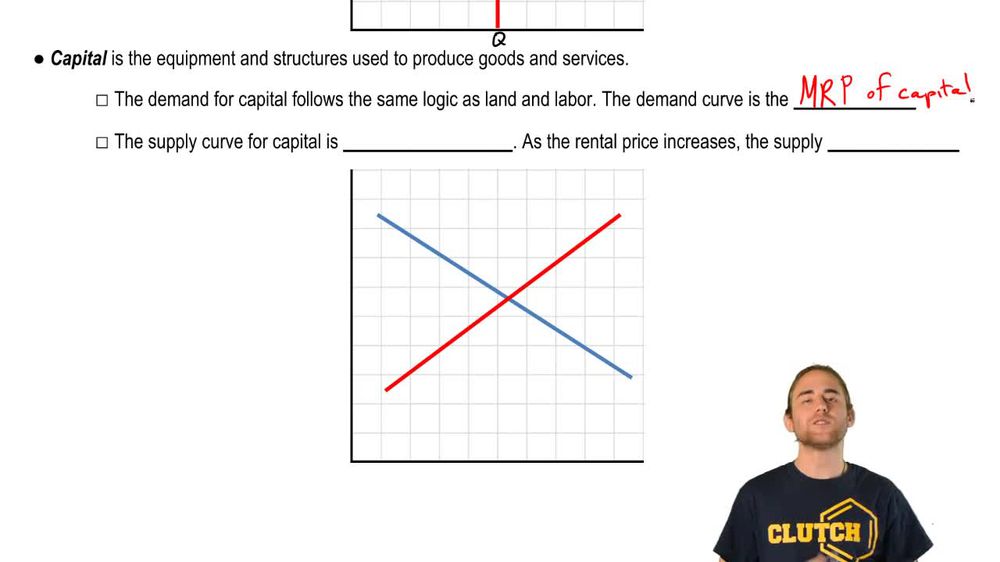
 02:08
02:08