Skip to main content
Macroeconomics
My Course
Learn
Exam Prep
AI Tutor
Study Guides
Flashcards
Explore
Try the app
My Course
Learn
Exam Prep
AI Tutor
Study Guides
Flashcards
Explore
Try the app
Back
Nominal Interest, Real Interest, and the Fisher Equation definitions
You can tap to flip the card.
Inflation
You can tap to flip the card.
👆
Inflation
General rise in prices over time, reducing the amount of goods or services money can buy.
Track progress
Control buttons has been changed to "navigation" mode.
1/13
Related flashcards
Related practice
Recommended videos
Nominal Interest, Real Interest, and the Fisher Equation quiz #1
Nominal Interest, Real Interest, and the Fisher Equation
10 Terms
Nominal Interest, Real Interest, and the Fisher Equation
11. Unemployment and Inflation
10 problems
Topic
Who is Affected by Inflation?
11. Unemployment and Inflation
10 problems
Topic
12. Unemployment and Inflation
8 topics
11 problems
Chapter
05:05
Nominal Interest, Real Interest, and the Fisher Equation
1
views
Terms in this set (13)
Hide definitions
Inflation
General rise in prices over time, reducing the amount of goods or services money can buy.
Consumer Price Index
Statistical measure tracking changes in the cost of a fixed basket of goods and services over time.
Nominal Interest Rate
Percentage return on savings or cost of borrowing, as stated by financial institutions, unadjusted for inflation.
Real Interest Rate
Interest rate adjusted for inflation, reflecting the true increase in purchasing power from saving or lending.
Purchasing Power
Ability of money to buy goods or services, often diminished by rising prices.
Fisher Equation
Approximate formula subtracting inflation from nominal interest to estimate the real interest rate.
Interest Rate
Percentage expressing the cost of borrowing funds or the reward for saving, based on the original amount.
Deflation
General decline in prices, increasing the value of money and potentially raising real interest above nominal.
Savings
Money set aside, typically in a bank, to earn interest and potentially grow in value over time.
Widgets
Hypothetical goods used in examples to illustrate changes in purchasing power and interest effects.
Financial Markets
Systems where funds are borrowed and lent, with interest rates influenced by inflation and other factors.
Mini Porcelain Figurines
Example goods used to demonstrate how inflation and interest rates affect what savings can purchase.
U.S. Interest Rates
Historical data showing periods where inflation outpaced nominal returns, reducing real gains for savers.
 BackBack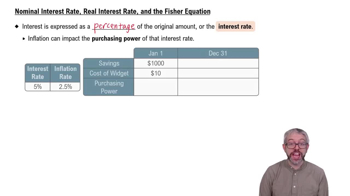
 05:05
05:05