Skip to main content
Macroeconomics
My Course
Learn
Exam Prep
AI Tutor
Study Guides
Flashcards
Explore
Try the app
My Course
Learn
Exam Prep
AI Tutor
Study Guides
Flashcards
Explore
Try the app
Back
Nominal Income and Real Income quiz
You can tap to flip the card.
What is nominal income?
You can tap to flip the card.
👆
What is nominal income?
Nominal income is the actual amount of money received, such as wages or salary, measured in current dollars without adjusting for inflation.
Track progress
Control buttons has been changed to "navigation" mode.
1/15
Related flashcards
Related practice
Recommended videos
Nominal Income and Real Income definitions
Nominal Income and Real Income
14 Terms
Nominal Income and Real Income
11. Unemployment and Inflation
10 problems
Topic
Nominal Interest, Real Interest, and the Fisher Equation
11. Unemployment and Inflation
10 problems
Topic
12. Unemployment and Inflation
8 topics
11 problems
Chapter
06:07
Nominal Income and Real Income
2
views
Terms in this set (15)
Hide definitions
What is nominal income?
Nominal income is the actual amount of money received, such as wages or salary, measured in current dollars without adjusting for inflation.
How is real income different from nominal income?
Real income adjusts nominal income for inflation, reflecting the actual purchasing power of the money received.
How do you calculate real income using the Consumer Price Index (CPI)?
Real income is calculated by dividing nominal income by the price index (CPI), with the CPI expressed as a decimal.
What does a CPI of 110 mean when calculating real income?
A CPI of 110 means you use 1.10 as the divisor when calculating real income.
If nominal income and the price index increase at the same rate, what happens to real income?
Real income remains constant, meaning purchasing power does not change.
What is purchasing power?
Purchasing power measures how much you can buy with a certain amount of money.
How does inflation affect purchasing power?
Inflation causes prices to rise, which reduces the amount of goods and services you can buy with the same amount of money.
In the example, what is the real income if nominal income is \$25,000 and CPI is 1.20?
The real income is \$20,833.33, reflecting the purchasing power equivalent to the base year.
What happens to real income if prices rise but nominal income stays the same?
Real income decreases because the same amount of money buys fewer goods and services.
Why do people seek raises during periods of inflation?
People seek raises to maintain or increase their purchasing power as inflation erodes the value of their income.
What is the formula for the percentage change in real income?
The percentage change in real income is approximately equal to the percentage change in nominal income minus the percentage change in the price level.
If nominal income increases by 20% and the price level increases by 10%, what is the approximate percentage change in real income?
The approximate percentage change in real income is 10% (20% - 10%).
In the example, what was the real income in year two if nominal income was \$50,000 and CPI was 1.05?
The real income was \$47,619, showing reduced purchasing power compared to year one.
What does it mean if your real income is lower in a later year despite having the same nominal income?
It means inflation has reduced your purchasing power, so your money buys less than before.
Why is the formula for percentage change in real income useful?
It provides a quick way to estimate how much inflation is impacting your real income without needing all the detailed data.
 BackBack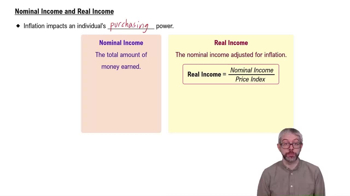
 06:07
06:07