Skip to main content
Macroeconomics
My Course
Learn
Exam Prep
AI Tutor
Study Guides
Flashcards
Explore
Try the app
My Course
Learn
Exam Prep
AI Tutor
Study Guides
Flashcards
Explore
Try the app
Back
Nominal GDP and Real GDP definitions
You can tap to flip the card.
Nominal GDP
You can tap to flip the card.
👆
Nominal GDP
Total value of final goods and services produced, calculated using current year prices, reflecting both price and quantity changes.
Track progress
Control buttons has been changed to "navigation" mode.
1/14
Related flashcards
Related practice
Recommended videos
Nominal GDP and Real GDP quiz #1
Nominal GDP and Real GDP
32 Terms
Nominal GDP and Real GDP
10. Measuring National Output and Income
10 problems
Topic
Calculating GDP Using the Income Approach
10. Measuring National Output and Income
8 problems
Topic
11. Gross Domestic Product (GDP) and Consumer Price Index (CPI)
7 topics
10 problems
Chapter
Guided course
09:15
Nominal GDP and Real GDP
5
views
Guided course
03:04
Inflation and the GDP Deflator
3
views
Terms in this set (14)
Hide definitions
Nominal GDP
Total value of final goods and services produced, calculated using current year prices, reflecting both price and quantity changes.
Real GDP
Total value of final goods and services produced, calculated using constant base year prices to isolate changes in production quantity.
Base Year
Reference period whose prices are used for calculating real GDP, allowing consistent comparison across different years.
Current Prices
Market values in effect during the year of production, used to compute nominal GDP and reflect inflation effects.
GDP Deflator
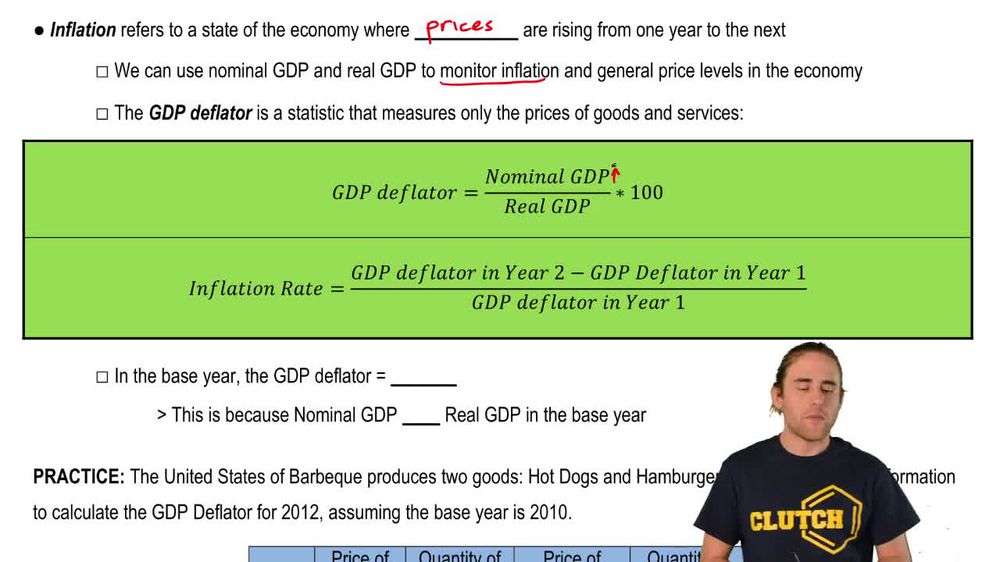
Index measuring overall price level changes, found by dividing nominal GDP by real GDP and multiplying by 100.
Inflation Rate
Percentage change in the GDP deflator from one year to the next, indicating the rise in general price levels.
Final Goods
Products and services purchased by end users, ensuring no double counting in GDP calculations.
Expenditures Approach
Method of calculating GDP by summing consumption, investment, government purchases, and net exports.
Quantity
Number of units of each good or service produced, multiplied by price to determine GDP contributions.
Chain Weighted Prices
Technique averaging prices over time to address changes in relative prices, improving real GDP accuracy.
Net Exports
Difference between a country's exports and imports, included in GDP to reflect international trade impact.
Government Purchases
Spending by the public sector on goods and services, forming a component of GDP.
Investment
Expenditures on capital goods that will be used for future production, included in GDP calculations.
Consumption
Household spending on goods and services, representing the largest component of GDP.
 BackBack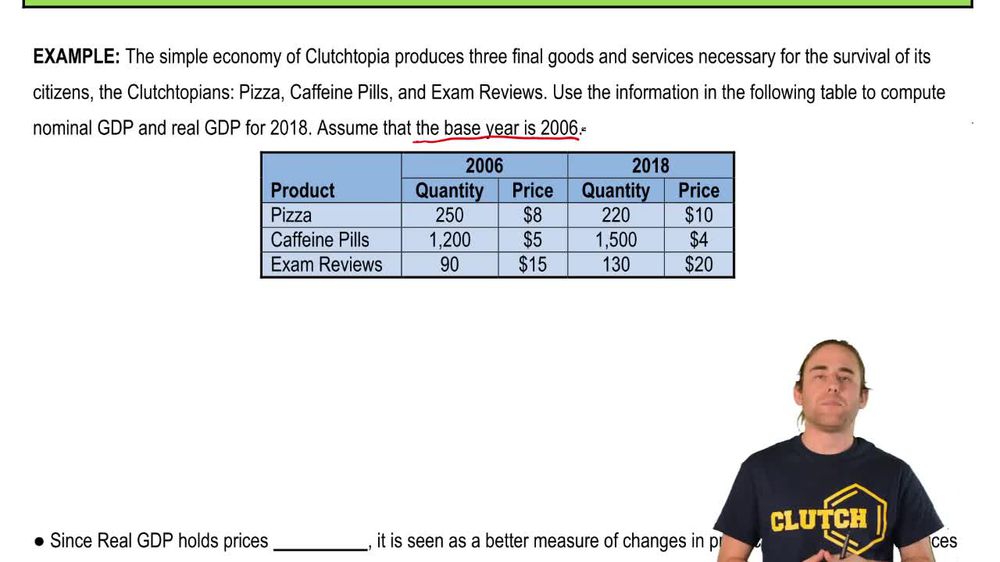
 09:15
09:15