What is the main focus of New Growth Theory in explaining economic growth?
New Growth Theory focuses on technological change as the key driver of productivity and economic growth.
How does New Growth Theory differ from traditional growth models regarding productivity?
It emphasizes technology and knowledge capital rather than just physical capital as the main sources of productivity growth.
What is knowledge capital according to New Growth Theory?
Knowledge capital is the total amount of knowledge and technology available in the economy, distinct from human capital.
How can firms increase their knowledge capital?
Firms can increase their knowledge capital by investing in research and development (R&D).
What is the difference between knowledge capital and human capital?
Knowledge capital refers to the available knowledge and technology, while human capital refers to the skills and education of workers.
Why does knowledge capital lead to increasing returns, unlike physical capital?
Knowledge capital leads to increasing returns because it benefits not just the firm but the entire economy, unlike physical capital which faces diminishing returns.
What does it mean for knowledge to be a public good?
Knowledge is a public good because it is non-rival (many can use it at once) and non-excludable (others cannot be easily prevented from using it).
How can other firms benefit from one firm's R&D according to New Growth Theory?
Other firms can benefit through free riding, using the knowledge generated by one firm's R&D to improve their own productivity.
What is the purpose of patents in supporting knowledge capital?
Patents give inventors exclusive rights to their inventions for 20 years, allowing them to profit from their innovation before it becomes public knowledge.
How long does a patent typically protect an invention in the United States?
A patent typically protects an invention for 20 years in the United States.
What happens to patented knowledge after the patent expires?
After the patent expires, the knowledge becomes a public good and can be used by anyone.
Besides patents, how else can governments support the accumulation of knowledge capital?
Governments can offer subsidies, grants, or tax breaks for research and development to encourage innovation.
How does investing in education support New Growth Theory's goals?
Investing in education increases human capital, making research and development more productive and likely to result in technological breakthroughs.
What is free riding in the context of knowledge capital?
Free riding occurs when firms benefit from the knowledge created by others without having to pay for its development.
Why is technological change considered crucial in New Growth Theory?
Technological change is crucial because it drives productivity growth and, therefore, long-term economic growth.
 Back
Back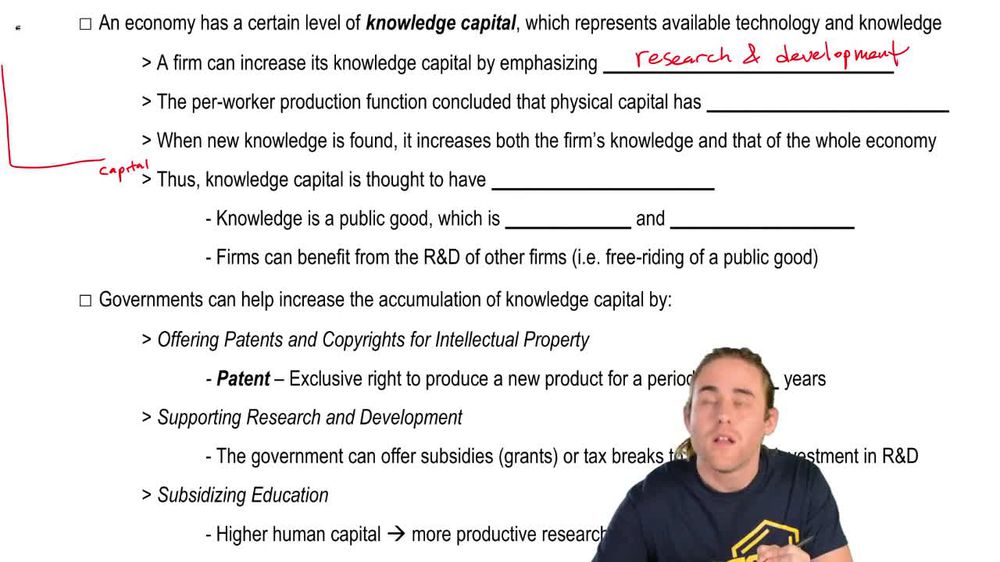
 06:15
06:15