How does the quantity produced by a monopoly compare to that produced under perfect competition?
A monopoly produces less than the efficient quantity produced under perfect competition.
What is deadweight loss in the context of a monopoly?
Deadweight loss is the loss of total surplus that occurs because a monopoly produces less than the efficient quantity, resulting in lost trades that would have benefited society.
How does the price set by a monopoly compare to the price in perfect competition?
A monopoly charges a higher price than the equilibrium price in perfect competition.
What happens to consumer surplus when a market becomes a monopoly?
Consumer surplus decreases because the monopoly raises prices and restricts output.
How does producer surplus change when a monopoly replaces perfect competition?
Producer surplus increases because the monopoly can charge higher prices, but some surplus is lost due to reduced quantity.
What is the total surplus in perfect competition compared to a monopoly?
Total surplus is maximized in perfect competition and is lower in a monopoly due to deadweight loss.
Why does a monopoly cause deadweight loss?
A monopoly causes deadweight loss because it restricts output below the efficient level, preventing mutually beneficial trades.
What is productive efficiency and does a monopoly achieve it?
Productive efficiency is producing at the lowest possible cost (minimum average total cost), and a monopoly does not achieve it.
What is allocative efficiency and does a monopoly achieve it?
Allocative efficiency occurs when production matches consumer preferences (marginal benefit equals marginal cost), and a monopoly does not achieve it.
In a monopoly, how is the price determined for the quantity produced?
The monopoly sets the price by finding the quantity where marginal revenue equals marginal cost, then charging the price on the demand curve at that quantity.
What happens to the areas labeled B and C on a surplus graph when moving from perfect competition to monopoly?
Area B shifts from consumer surplus to producer surplus, while area C becomes part of the deadweight loss.
Why do monopolies not produce at the minimum of the average total cost curve?
Monopolies do not produce at the minimum average total cost because they restrict output to maximize profit, operating on the downward-sloping part of the curve.
What does the deadweight loss area represent on a monopoly graph?
The deadweight loss area represents the surplus from trades that do not occur due to the monopoly's restricted output.
How does the marginal benefit compare to marginal cost in a monopoly at the quantity produced?
In a monopoly, the marginal benefit to consumers exceeds the marginal cost at the quantity produced, indicating allocative inefficiency.
What is the main reason monopolies are considered inefficient compared to perfectly competitive markets?
Monopolies are inefficient because they do not achieve productive or allocative efficiency, resulting in higher prices, lower output, and deadweight loss.
 Back
Back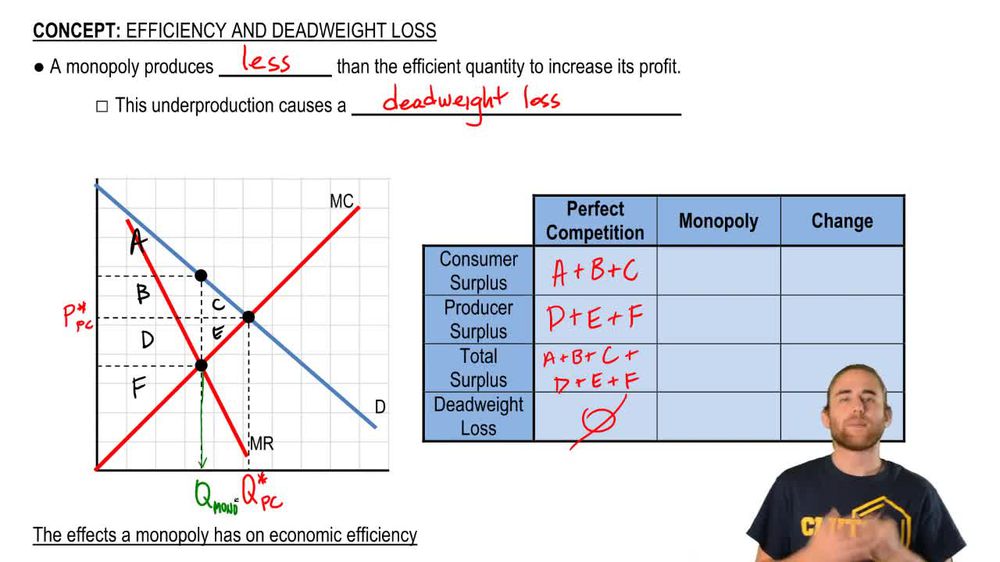
 12:19
12:19