Where does a firm in monopolistic competition maximize profit on the graph?
A firm maximizes profit where marginal revenue equals marginal cost (MR=MC). This is also the point where losses are minimized if the firm is not profitable.
How is the profit-maximizing quantity determined in monopolistic competition?
The profit-maximizing quantity is found at the intersection of the marginal revenue and marginal cost curves. This is the quantity the firm should produce.
What formula is used to calculate profit or loss in monopolistic competition?
Profit or loss is calculated as (Price - Average Total Cost) × Quantity. Price is found on the demand curve, and ATC is found on the ATC curve at the profit-maximizing quantity.
Where do you find the price for calculating profit in monopolistic competition?
The price is found on the demand curve at the profit-maximizing quantity. This is the price the firm can charge for its product.
How do you find the average total cost (ATC) for profit calculation?
ATC is found on the average total cost curve at the profit-maximizing quantity. This value is used in the profit formula.
What does it mean if price is greater than average total cost at the profit-maximizing quantity?
If price exceeds ATC, the firm earns a profit. The area between the price and ATC curves represents the total profit.
What happens if average total cost is greater than price at the profit-maximizing quantity?
If ATC is greater than price, the firm incurs a loss. The area between the ATC and price curves represents the total loss.
Why is the profit-maximizing quantity also called the loss-minimizing quantity?
Producing at MR=MC minimizes losses if the firm cannot earn a profit. Any other quantity would result in a larger loss.
How is the profit or loss visually represented on the graph?
Profit or loss is shown as the area of the rectangle between the price and ATC curves at the profit-maximizing quantity. The rectangle's size indicates the total profit or loss.
What is the key difference between monopolistic competition and perfect competition in profit calculation?
In monopolistic competition, the marginal revenue curve is separate from the demand curve, unlike perfect competition where they are the same. This affects how price and quantity are determined.
Why is the marginal revenue curve always below the demand curve in monopolistic competition?
The marginal revenue curve is below the demand curve because firms must lower the price to sell additional units. This results in marginal revenue being less than price.
What curves are needed to calculate profit or loss in monopolistic competition?
You need the marginal revenue, marginal cost, demand, and average total cost curves. These curves help determine the profit-maximizing quantity, price, and ATC.
What happens to profit if the average total cost curve is above the demand curve at the profit-maximizing quantity?
The firm incurs a loss because ATC is higher than price. The loss is minimized by producing at MR=MC.
How does the area of the rectangle between price and ATC curves relate to profit or loss?
The area represents the total profit if price is above ATC, or total loss if ATC is above price. It is calculated for all units produced at the profit-maximizing quantity.
What is the significance of finding price and ATC at the profit-maximizing quantity?
Finding price and ATC at this quantity allows you to accurately calculate profit or loss. These values are essential for applying the profit formula.
 Back
Back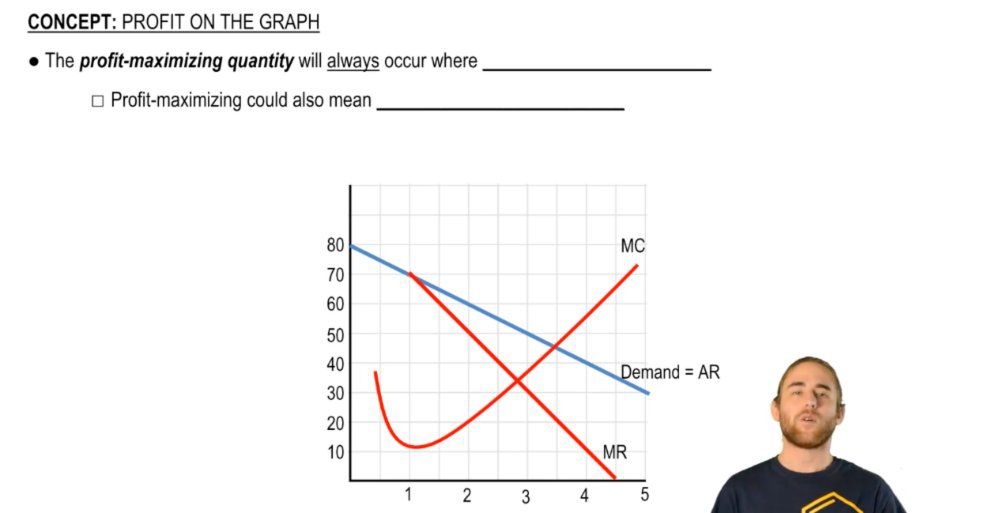
 07:07
07:07