Skip to main content
Macroeconomics
My Course
Learn
Exam Prep
AI Tutor
Study Guides
Flashcards
Explore
Try the app
My Course
Learn
Exam Prep
AI Tutor
Study Guides
Flashcards
Explore
Try the app
Back
Mergers and the Herfindahl-Hirschman Index (HHI) definitions
You can tap to flip the card.
Merger
You can tap to flip the card.
👆
Merger
A combination of two separate firms into a single entity, often altering market structure and competition.
Track progress
Control buttons has been changed to "navigation" mode.
1/14
Related flashcards
Recommended videos
Mergers and the Herfindahl-Hirschman Index (HHI) quiz
Mergers and the Herfindahl-Hirschman Index (HHI)
15 Terms
Guided course
04:42
Mergers and the HHI
1
views
Terms in this set (14)
Hide definitions
Merger
A combination of two separate firms into a single entity, often altering market structure and competition.
Horizontal Merger
A union of firms within the same industry, often scrutinized for its potential to reduce market competition.
Vertical Merger
A combination of firms at different production stages, typically raising fewer regulatory concerns.
Market Power
The ability of a firm or group to influence prices or control market outcomes due to their size or position.
Competition
The rivalry among firms striving for greater market share, often benefiting consumers through better choices.
Herfindahl-Hirschman Index
A numerical measure of market concentration, calculated by summing the squares of firms' market shares.
Market Concentration
The extent to which a small number of firms dominate total sales or output in an industry.
Market Share
A firm's portion of total industry sales or revenue, expressed as a percentage of the market.
Monopoly
A market structure where a single firm controls the entire supply, holding 100% of market share.
Regulatory Approval
Official permission required from government authorities before firms can complete a merger.
Low Concentration
A market condition indicated by an HHI below 1500, suggesting minimal dominance by any firm.
Moderate Concentration
A market state with an HHI between 1500 and 2500, where mergers receive increased regulatory scrutiny.
High Concentration
A scenario where the HHI exceeds 2500, signaling significant market dominance and likely regulatory intervention.
Industry
A group of firms producing similar or related products, forming the context for market competition and mergers.
 BackBack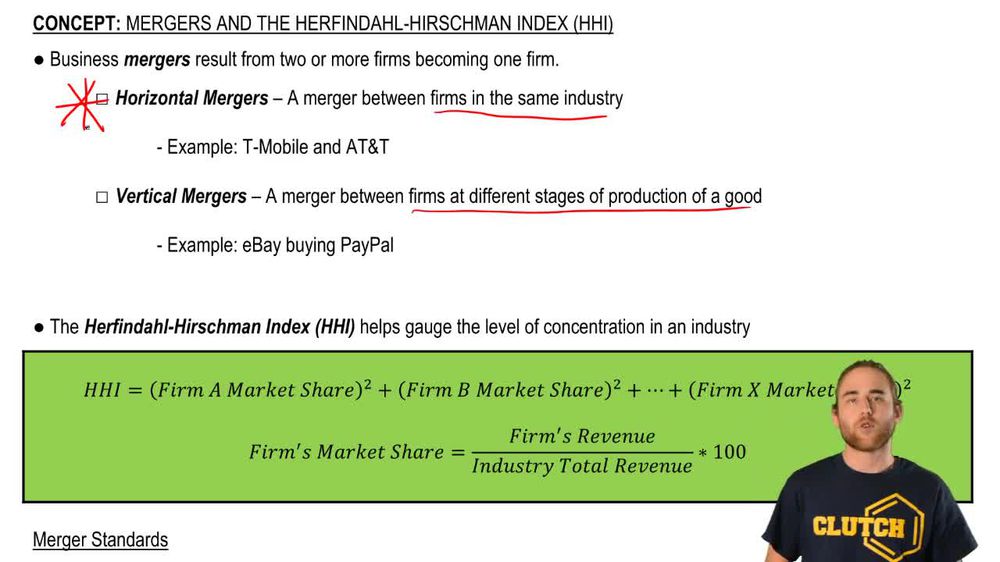
 04:42
04:42