The median voter theorem states that the preference of the median voter will determine the outcome of an election, as voters choose the option closest to their own preference.
How is the median defined in a data set?
The median is the value that separates the higher half of a data set from the lower half, representing the middle value when the data is ordered.
In the example with military spending preferences, what was the median value?
The median value was 50, which was the middle preference among the five voters.
Why do voters choose options closest to their preferences in elections?
Voters choose the closest option because they may not get their exact preference, so they select the alternative nearest to what they want.
What happens when the vote is between \$20 and \$50 military budgets?
Three voters choose \$50 and two choose \$20, so \$50 wins the vote.
What is the outcome when the vote is between \$50 and \$100 military budgets?
Three voters choose \$50 and two choose \$100, so \$50 again wins the vote.
Why does the median preference win in both voting scenarios presented?
The median wins because voters on either side of the median prefer it over more extreme alternatives, resulting in majority support.
What is the implication of the median voter theorem for people dissatisfied with the outcome?
Many people may be dissatisfied because the winning option is not their exact preference, but the median voter gets their preferred outcome.
How might people respond if they consistently do not get their preferred policy outcomes?
People may relocate to jurisdictions where the median vote is closer to their preferences, seeking to become the median voter.
What does the median voter theorem suggest about equilibrium in collective choice?
It suggests that the outcome reflects an equilibrium where the median preference dominates, balancing aggregate demand and supply.
How does the median voter theorem relate to fiscal policies like budget constraints?
The theorem shows that fiscal policies, such as government outlays, are often shaped by the preferences of the median voter.
What happens to the outcome if the median voter changes?
If the median voter changes, the policy outcome will shift to match the new median preference.
Why is understanding the median voter theorem important in political economy?
It helps analyze voting behavior and understand how collective decisions are made based on the distribution of preferences.
What is the process for finding the median in a five-number data set?
Remove the highest and lowest numbers repeatedly until one number remains; that number is the median.
What does the median voter theorem imply about the power of the median voter?
The median voter has significant power, as their preference determines the winning policy in majority-rule voting.
 Back
Back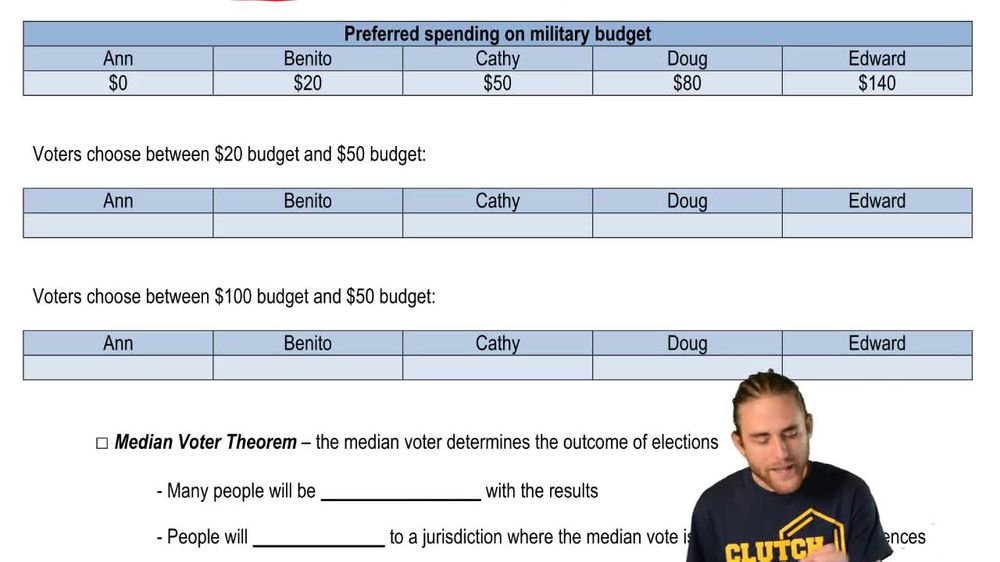
 06:42
06:42