Skip to main content
Macroeconomics
My Course
Learn
Exam Prep
AI Tutor
Study Guides
Flashcards
Explore
Try the app
My Course
Learn
Exam Prep
AI Tutor
Study Guides
Flashcards
Explore
Try the app
Back
Long Run Entry and Exit Decision quiz
You can tap to flip the card.
What is the key condition for a firm to exit a market in the long run?
You can tap to flip the card.
👆
What is the key condition for a firm to exit a market in the long run?
A firm will exit the market in the long run if the price is less than its average total cost (P < ATC), meaning it cannot earn a profit.
Track progress
Control buttons has been changed to "navigation" mode.
1/15
Related flashcards
Recommended videos
Long Run Entry and Exit Decision definitions
Long Run Entry and Exit Decision
15 Terms
Guided course
06:04
Long Run Exit/Enter Decision (continued)
1
views
Guided course
09:32
Long Run Exit/Enter Decision on the Graph
1
views
Guided course
02:39
Long Run Exit/Enter Decision
1
views
Terms in this set (15)
Hide definitions
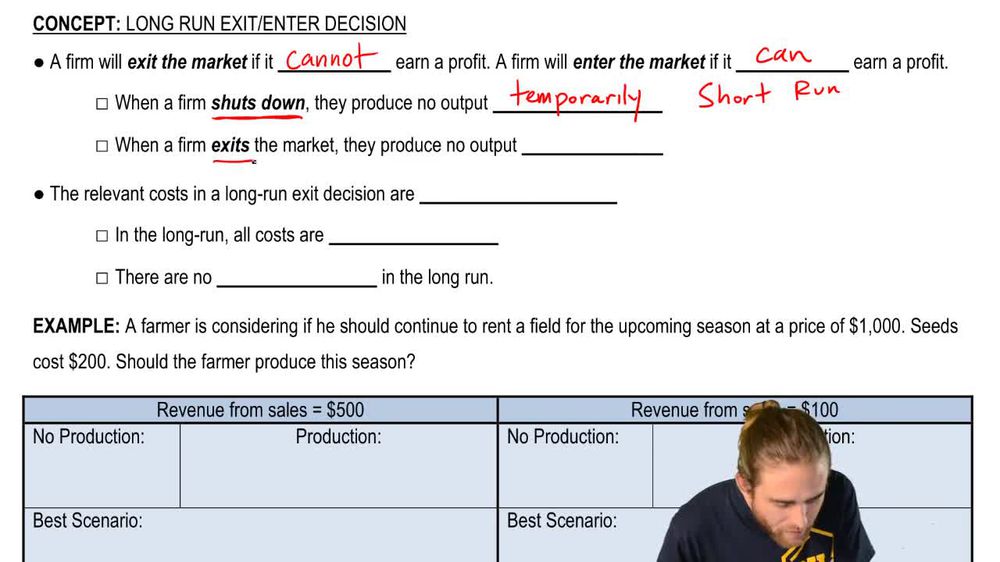
What is the key condition for a firm to exit a market in the long run?
A firm will exit the market in the long run if the price is less than its average total cost (P < ATC), meaning it cannot earn a profit.
How do long run exit decisions differ from short run shutdown decisions?
Long run exit decisions consider all costs (no fixed costs remain), while short run shutdowns only consider variable costs.
What happens to fixed costs in the long run?
In the long run, fixed costs become variable, as firms can change or eliminate them.
When will a firm enter a market in the long run?
A firm will enter a market if the price is greater than average total cost (P > ATC), indicating profitability.
What is the exit condition formula for the long run?
The exit condition is P < ATC, where price is less than average total cost.
Why is average total cost (ATC) used for long run decisions instead of average variable cost (AVC)?
Because all costs are variable in the long run, so ATC reflects the true cost of production.
What is the economic profit at the point where price equals average total cost?
Economic profit is zero when price equals average total cost, as all opportunity costs are covered.
What happens if a firm’s total revenue is less than its total cost in the long run?
The firm will exit the market, as it cannot cover its costs and earn a profit.
How does the ability to avoid paying for fixed assets (like a field lease) affect long run decisions?
In the long run, firms can avoid paying for fixed assets, so they can exit without incurring those costs.
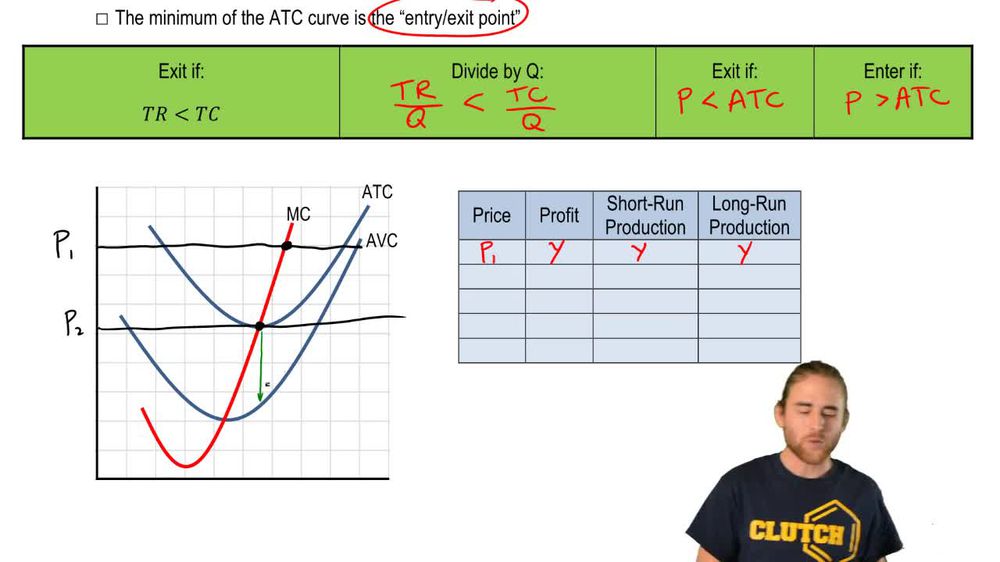
What is the significance of the minimum point of the ATC curve in long run entry and exit?
The minimum point of the ATC curve is the threshold; firms enter if price is above it and exit if price is below it.
How does opportunity cost factor into economic profit calculations?
Economic profit includes opportunity costs, so zero economic profit means all explicit and implicit costs are covered.
What happens in the long run if price is between AVC and ATC?
The firm may produce in the short run but will exit in the long run, as price does not cover ATC.
What is the outcome for a firm if price is below AVC?
The firm will not produce in either the short run or long run, as it cannot cover even its variable costs.
How does the long run entry and exit decision affect market equilibrium?
Entry and exit of firms in response to profit opportunities adjusts aggregate supply and demand, influencing equilibrium.
What curve is most relevant for long run entry and exit decisions?
The average total cost (ATC) curve is most relevant for long run entry and exit decisions.
 BackBack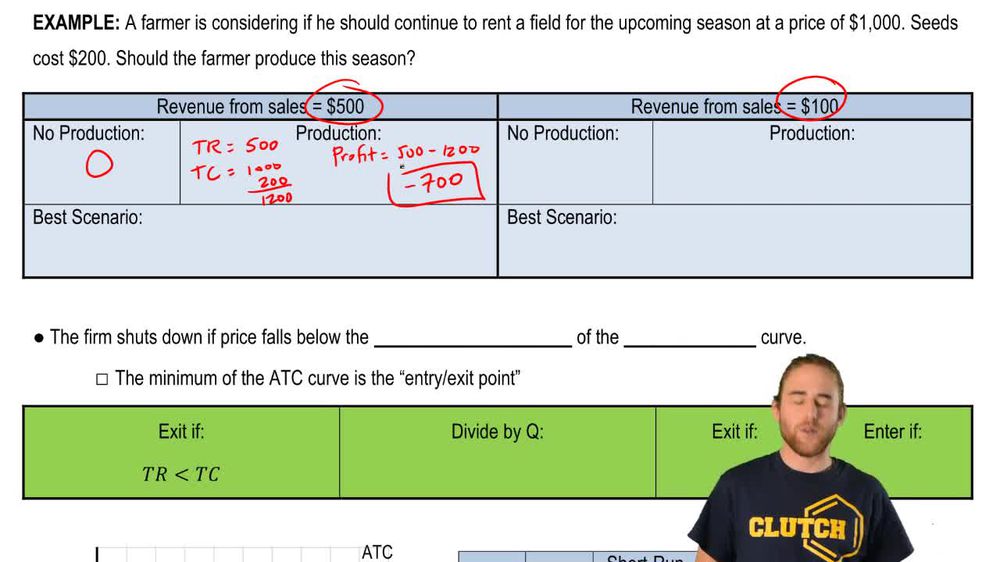
 06:04
06:04