Skip to main content
Macroeconomics
My Course
Learn
Exam Prep
AI Tutor
Study Guides
Flashcards
Explore
Try the app
My Course
Learn
Exam Prep
AI Tutor
Study Guides
Flashcards
Explore
Try the app
Back
Introduction to the Four Market Models definitions
You can tap to flip the card.
Market Structure
You can tap to flip the card.
👆
Market Structure
Classification system for markets based on supplier count, influencing competition, pricing, and firm behavior.
Track progress
Control buttons has been changed to "navigation" mode.
1/13
Related flashcards
Recommended videos
Introduction to the Four Market Models quiz
Introduction to the Four Market Models
15 Terms
Guided course
02:25
Four Market Model Summary
Terms in this set (13)
Hide definitions
Market Structure
Classification system for markets based on supplier count, influencing competition, pricing, and firm behavior.
Perfect Competition
Scenario with countless suppliers and buyers, resulting in price-taking and no single firm influencing the market price.
Monopolistic Competition
Environment with many suppliers offering differentiated products, allowing for some control over pricing.
Oligopoly
Market dominated by a small number of firms, where each can impact overall market outcomes.
Monopoly
Situation where a single supplier controls the entire market, setting prices without competition.
Supplier
Entity providing goods or services within a market, crucial for determining market structure.
Buyer
Participant in a market who purchases goods or services, influencing demand and market dynamics.
Price-Taking Behavior
Condition where individual firms accept the market price as given, unable to influence it.
Product Differentiation
Distinction among goods or services that allows firms to set prices above marginal cost.
Competition
Rivalry among firms within a market, shaping pricing, output, and innovation.
Aggregate Demand
Total quantity of goods and services demanded across all markets in an economy.
Supply Shock
Unexpected event that alters the availability of goods or services, impacting prices and output.
Market Equilibrium
State where quantity supplied equals quantity demanded, resulting in stable prices.
 BackBack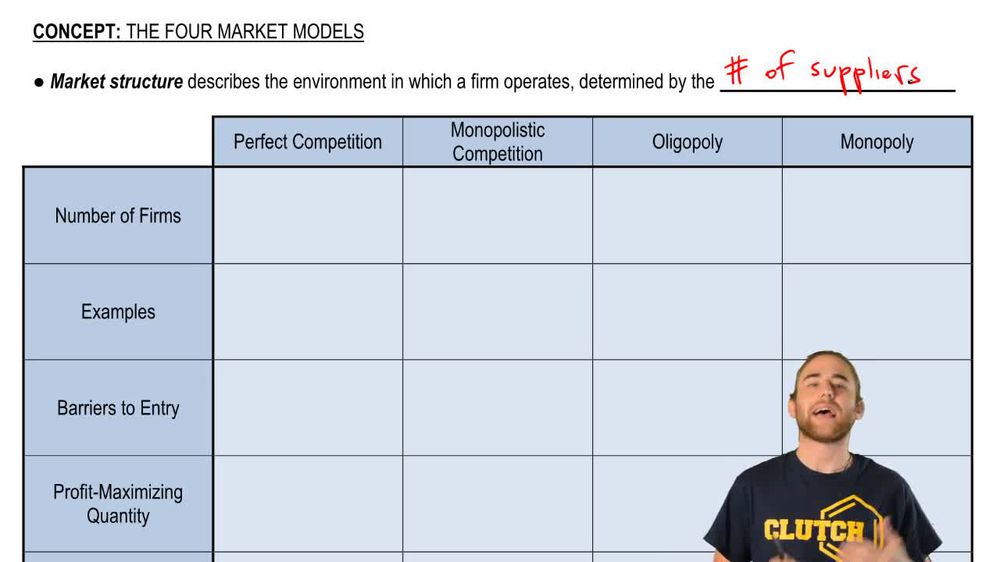
 02:25
02:25