Skip to main content
Macroeconomics
My Course
Learn
Exam Prep
AI Tutor
Study Guides
Flashcards
Explore
Try the app
My Course
Learn
Exam Prep
AI Tutor
Study Guides
Flashcards
Explore
Try the app
Back
Introducing Taxes and Tax Incidence definitions
You can tap to flip the card.
Public Services
You can tap to flip the card.
👆
Public Services
Essential functions like education, police, and fire protection funded by government revenue from compulsory charges.
Track progress
Control buttons has been changed to "navigation" mode.
1/13
Related flashcards
Related practice
Recommended videos
Introducing Taxes and Tax Incidence quiz
Introducing Taxes and Tax Incidence
15 Terms
Introducing Taxes and Tax Incidence
6. Introduction to Taxes
10 problems
Topic
Effects of Taxes on a Market
6. Introduction to Taxes
10 problems
Topic
6. Introduction to Taxes
6 topics
14 problems
Chapter
Guided course
03:21
Tax Incidence
9
views
Guided course
13:27
Taxes and Tax Incidence
9
views
Terms in this set (13)
Hide definitions
Public Services
Essential functions like education, police, and fire protection funded by government revenue from compulsory charges.
Per Unit Tax
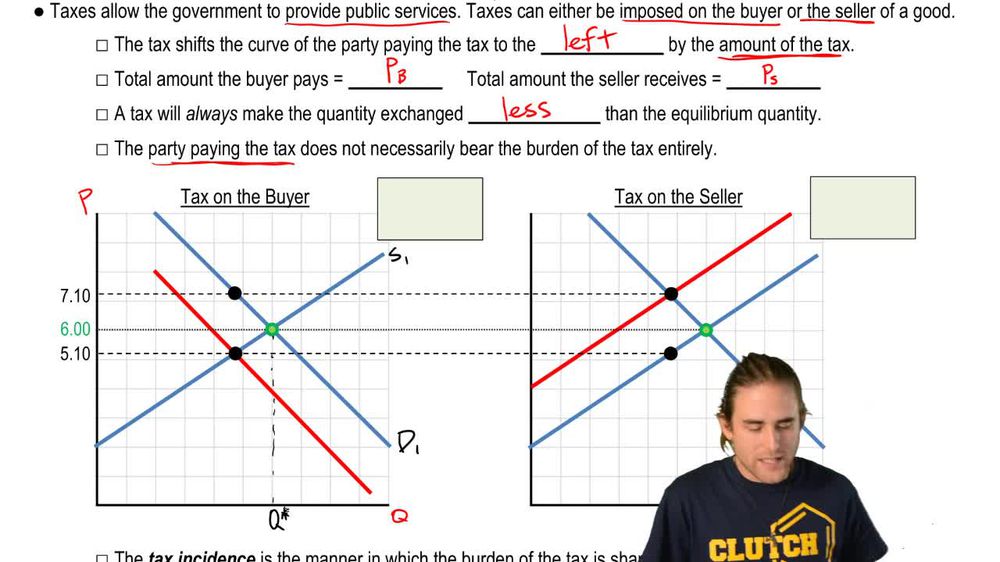
A fixed charge applied to each item exchanged, increasing total cost for every additional unit bought or sold.
Demand Curve
A graphical representation showing the relationship between price and quantity desired by buyers in a market.
Supply Curve
A graphical line illustrating how much sellers are willing to offer at various prices in a market.
Equilibrium Price
The market value where the quantity supplied matches the quantity demanded before any external intervention.
Equilibrium Quantity
The amount of goods exchanged where market supply and demand intersect without outside influence.
Market Inefficiency
A situation where resources are not allocated optimally, often resulting from external interventions like taxes.
Tax Incidence
The division of a compulsory charge's burden between buyers and sellers, determined by market adjustments.
Price to Buyer
The total amount paid by purchasers, including both the good's cost and any compulsory charges.
Price to Seller
The net amount received by suppliers after any compulsory charges are deducted from the transaction.
Curve Shift
A movement of the supply or demand line, typically leftward, reflecting the impact of external factors like compulsory charges.
Tax Burden
The share of a compulsory charge absorbed by each market participant, often expressed in dollars or percentages.
Graphical Representation
A visual tool used to illustrate how compulsory charges affect market prices, quantities, and participant outcomes.
 BackBack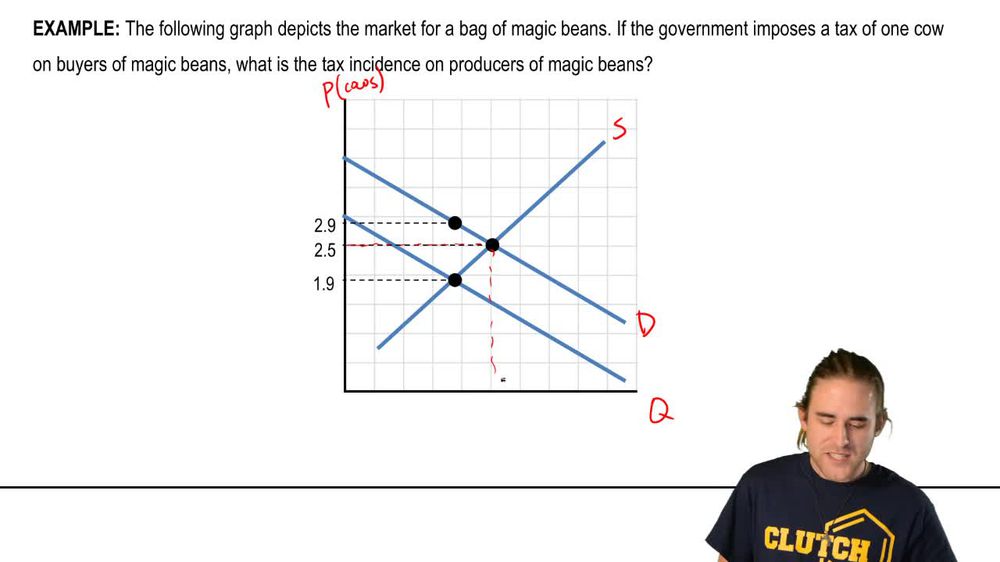
 03:21
03:21