Skip to main content
Macroeconomics
My Course
Learn
Exam Prep
AI Tutor
Study Guides
Flashcards
Explore
Try the app
My Course
Learn
Exam Prep
AI Tutor
Study Guides
Flashcards
Explore
Try the app
Back
Indifference Curves definitions
You can tap to flip the card.
Indifference Curve
You can tap to flip the card.
👆
Indifference Curve
A graphical representation showing all combinations of two goods that yield identical satisfaction for a consumer.
Track progress
Control buttons has been changed to "navigation" mode.
1/14
Related flashcards
Recommended videos
Indifference Curves quiz
Indifference Curves
15 Terms
Guided course
14:47
Indifference Curves
Guided course
04:23
Properties of Indifference Curves
Terms in this set (14)
Hide definitions
Indifference Curve
A graphical representation showing all combinations of two goods that yield identical satisfaction for a consumer.
Utility
A measure of satisfaction or happiness derived from consuming goods, often quantified in abstract units called utils.
Util
An abstract unit used to quantify the satisfaction or happiness a consumer receives from consumption.
Consumption Bundle
A specific combination of quantities of different goods chosen by a consumer.
Marginal Utility
The extra satisfaction gained from consuming one additional unit of a good, typically decreasing with each unit.
Law of Diminishing Returns
A principle stating that as more of a good is consumed, the added satisfaction from each extra unit declines.
Marginal Rate of Substitution
The rate at which a consumer is willing to exchange one good for another while maintaining the same satisfaction level.
Slope
A measure indicating how much of one good must be given up to gain more of another, represented by the steepness of the curve.
Indifference Curve Map
A collection of multiple indifference curves, each representing different satisfaction levels for a consumer.
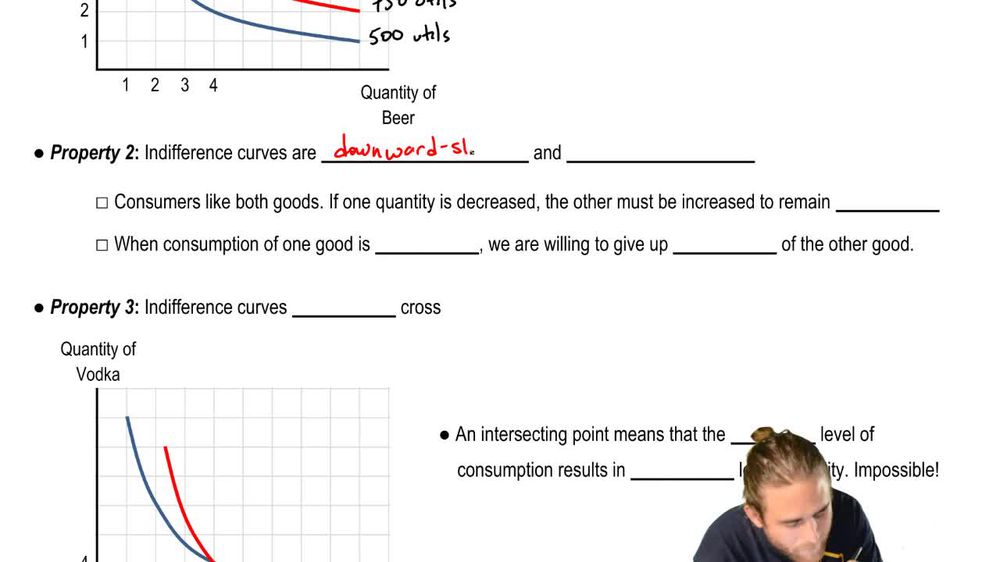
Downward Sloping
A property where increasing one good requires decreasing the other to keep satisfaction unchanged, resulting in a negative slope.
Bowing Inward
A shape characteristic where the curve bends toward the origin, reflecting a changing willingness to substitute goods.
Non-Intersection
A property ensuring that no two curves representing different satisfaction levels ever cross each other.
Higher Indifference Curve
A curve representing greater satisfaction and higher consumption compared to those closer to the origin.
Budget Constraint
A boundary showing all combinations of goods a consumer can afford, independent of their satisfaction.
 BackBack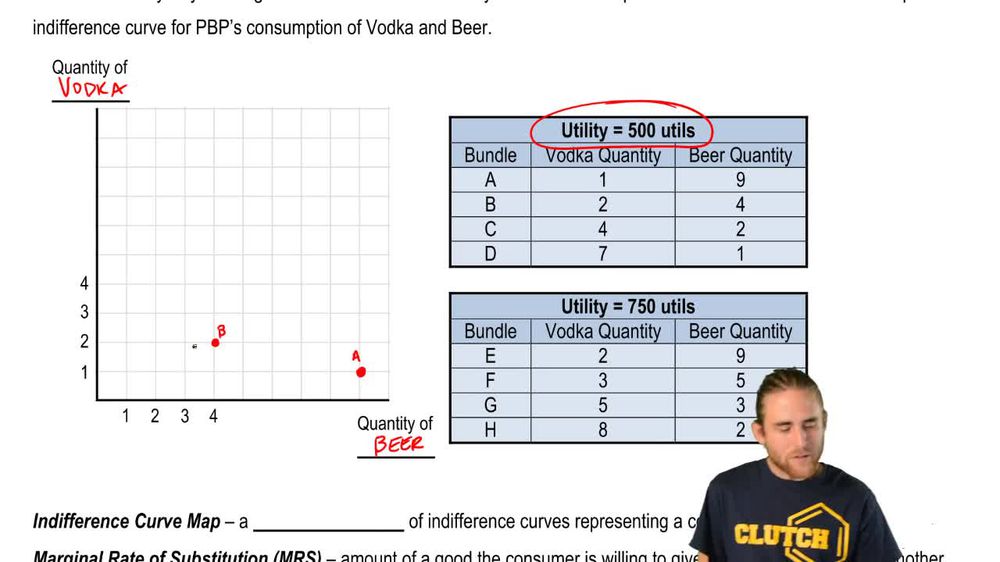
 14:47
14:47