Skip to main content
Macroeconomics
My Course
Learn
Exam Prep
AI Tutor
Study Guides
Flashcards
Explore
Try the app
My Course
Learn
Exam Prep
AI Tutor
Study Guides
Flashcards
Explore
Try the app
Back
Goals of Monetary Policy definitions
You can tap to flip the card.
Monetary Policy
You can tap to flip the card.
👆
Monetary Policy
Management of the nation's money supply by the central bank to achieve economic objectives like stable prices and high employment.
Track progress
Control buttons has been changed to "navigation" mode.
1/14
Related flashcards
Related practice
Recommended videos
Goals of Monetary Policy quiz #1
Goals of Monetary Policy
12 Terms
Goals of Monetary Policy
18. Monetary Policy
9 problems
Topic
The Demand for Money
18. Monetary Policy
10 problems
Topic
19. Monetary Policy
8 topics
14 problems
Chapter
Guided course
03:28
Goals of Monetary Policy
7
views
Terms in this set (14)
Hide definitions
Monetary Policy
Management of the nation's money supply by the central bank to achieve economic objectives like stable prices and high employment.
Money Supply
Total amount of liquid currency and deposits available in the economy, commonly measured by M1 and M2.
Federal Reserve
Central banking system of the United States responsible for regulating the money supply and overseeing financial stability.
Price Stability
Condition where inflation is controlled, ensuring money retains its purchasing power over time.
Inflation
General increase in prices, which reduces the purchasing power of money if not kept in check.
High Employment
Economic state where most resources, especially labor, are fully utilized, keeping GDP near its potential.
Gross Domestic Product
Total value of all goods and services produced within a country, reflecting overall economic activity.
Stability of Financial Markets
Condition where financial institutions and markets function smoothly, preventing crises and failures.
Lender of Last Resort
Role of the central bank in providing emergency funds to financial institutions to prevent systemic collapse.
Economic Growth
Sustained increase in a nation's output and income, often driven by investment and efficient resource use.
Interest Rate
Cost of borrowing money, which influences the level of investment and overall economic activity.
Investment
Expenditure by firms on capital goods, influenced by borrowing costs and crucial for expanding productive capacity.
Commercial Bank
Financial institution accepting deposits and making loans, traditionally the main focus of central bank oversight.
Investment Bank
Financial institution involved in securities trading and underwriting, included in central bank actions since 2008.
 BackBack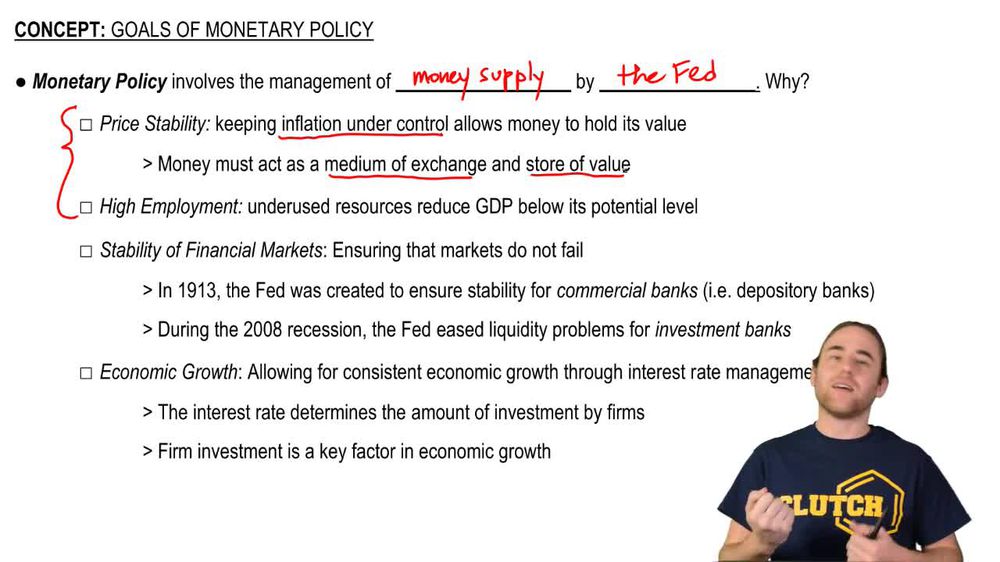
 03:28
03:28