Skip to main content
Macroeconomics
My Course
Learn
Exam Prep
AI Tutor
Study Guides
Flashcards
Explore
Try the app
My Course
Learn
Exam Prep
AI Tutor
Study Guides
Flashcards
Explore
Try the app
Back
Game Theory and Oligopoly Profit definitions
You can tap to flip the card.
Oligopoly
You can tap to flip the card.
👆
Oligopoly
A market structure with a few firms whose decisions are mutually dependent, leading to strategic behavior and interdependence.
Track progress
Control buttons has been changed to "navigation" mode.
1/15
Related flashcards
Recommended videos
Game Theory and Oligopoly Profit quiz
Game Theory and Oligopoly Profit
15 Terms
Guided course
10:08
Oligopoly Profit
Guided course
06:36
Oligopoly Profit
Terms in this set (15)
Hide definitions
Oligopoly
A market structure with a few firms whose decisions are mutually dependent, leading to strategic behavior and interdependence.
Duopoly
A special case of an oligopoly with only two producers, where each firm's actions directly affect the other.
Interdependence
A situation where firms must consider rivals' choices when making their own output or pricing decisions.
Collusion
An agreement among firms to coordinate output or prices to maximize joint profits, often resembling monopoly outcomes.
Incentive to Cheat
A temptation for firms to break cooperative agreements to increase individual profit, undermining collective outcomes.
Monopoly
A market with a single producer who maximizes profit by choosing output and price without competition.
Perfect Competition
A market with many firms where price equals marginal cost, leading to maximum efficiency and zero economic profit.
Demand Curve
A graphical representation showing the inverse relationship between price and quantity demanded in a market.
Total Profit
The sum of all firms' profits in a market, influenced by output decisions and market structure.
Payoff Matrix
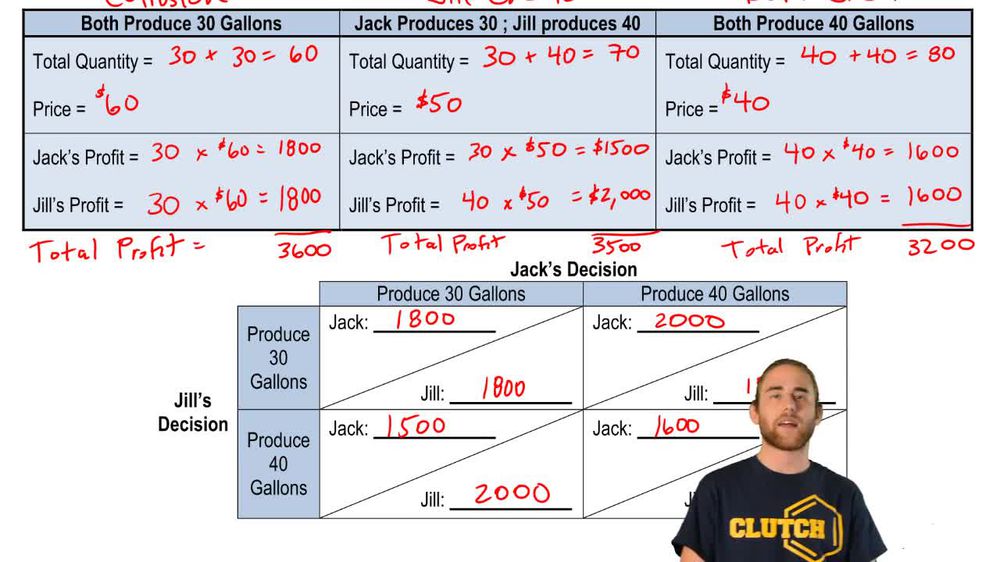
A table displaying possible profits for each firm based on the combination of strategies chosen by all players.
Dominant Strategy
A choice that yields a higher payoff for a firm regardless of competitors' actions.
Nash Equilibrium
An outcome where no firm can improve its profit by changing its strategy while others keep theirs unchanged.
Prisoner's Dilemma
A scenario where rational self-interest leads firms to a less optimal outcome than if they had cooperated.
Market Power
The ability of a firm to influence market price and output, often reduced as competition increases.
Aggregate Supply
The total quantity of goods produced by all firms in a market, shaped by strategic interactions in oligopolies.
 BackBack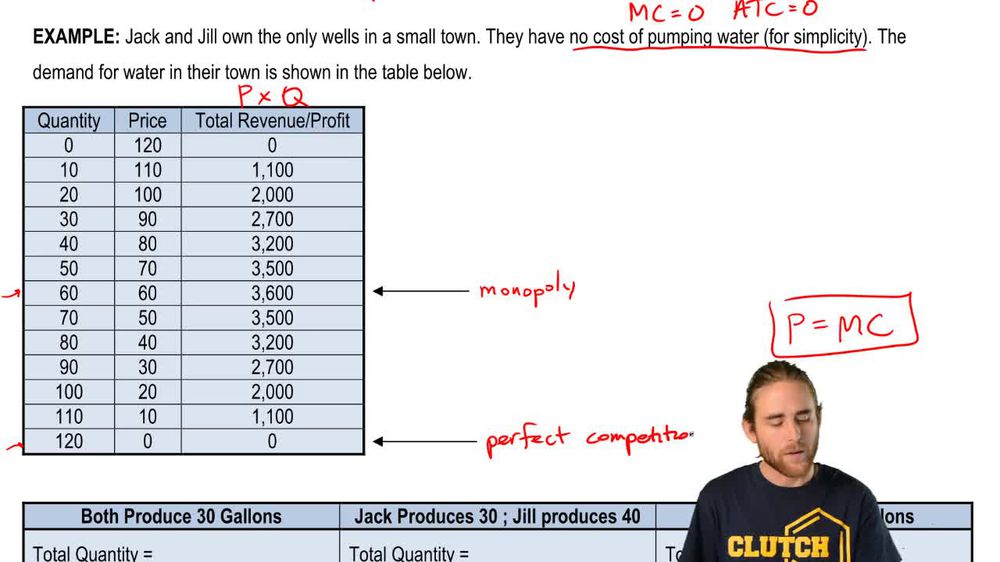
 10:08
10:08