Skip to main content
Macroeconomics
My Course
Learn
Exam Prep
AI Tutor
Study Guides
Flashcards
Explore
Try the app
My Course
Learn
Exam Prep
AI Tutor
Study Guides
Flashcards
Explore
Try the app
Back
Four Types of Goods and Two Characteristics definitions
You can tap to flip the card.
Rivalry
You can tap to flip the card.
👆
Rivalry
Occurs when one person's use of a product prevents others from using that same unit at the same time.
Track progress
Control buttons has been changed to "navigation" mode.
1/14
Related flashcards
Related practice
Recommended videos
Four Types of Goods and Two Characteristics quiz
Four Types of Goods and Two Characteristics
15 Terms
Four Types of Goods and Two Characteristics
8. The Types of Goods
10 problems
Topic
The Free Rider Problem and the Tragedy of the Commons
8. The Types of Goods
10 problems
Topic
8. The Types of Goods
3 topics
15 problems
Chapter
04:47
Rivalry and Excludability
05:41
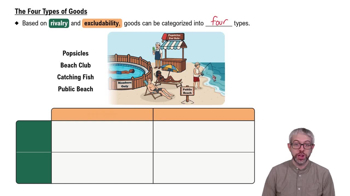
The Four Types of Goods: Private Goods, Club Goods, Common Resources, and Public Goods
Terms in this set (14)
Hide definitions
Rivalry
Occurs when one person's use of a product prevents others from using that same unit at the same time.
Excludability
Describes whether access to a product can be restricted to those who have paid for it.
Private Goods
Characterized by both restricted access and individual use, such as items bought in stores.
Club Goods
Allow simultaneous use by many but require payment or membership for access.
Common Resources
Accessible to all without payment but can be depleted by individual use, like fish in the ocean.
Public Goods
Available to everyone without payment and can be used by many at once without reducing availability.
Nonrivalry
Means multiple people can use a product at the same time without affecting each other's enjoyment.
Nonexcludability
Indicates that people cannot be prevented from accessing a product, even if they don't pay.
Overuse
Happens when unrestricted access leads to depletion or exhaustion of a resource.
Regulation
Involves rules or policies designed to manage access and prevent depletion of shared resources.
Supply and Demand Model
A framework used to analyze how different types of goods interact in markets, especially regarding access and consumption.
Fireworks Display
An example of a product that can be enjoyed by many simultaneously without payment or restriction.
Streaming Service
A digital product allowing multiple users at once, but requiring payment for access.
Public Park
A location accessible to all without payment, often maintained by the government for communal use.
 BackBack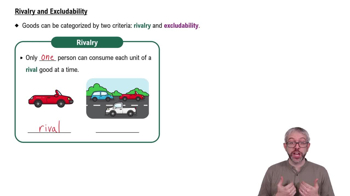
 04:47
04:47