Skip to main content
Macroeconomics
My Course
Learn
Exam Prep
AI Tutor
Study Guides
Flashcards
Explore
Try the app
My Course
Learn
Exam Prep
AI Tutor
Study Guides
Flashcards
Explore
Try the app
Back
Investment, Savings, and the Financial System definitions
You can tap to flip the card.
Economic Investment
You can tap to flip the card.
👆
Economic Investment
Allocation of resources by firms toward assets like factories or technology to boost future production.
Track progress
Control buttons has been changed to "navigation" mode.
1/15
Related flashcards
Related practice
Recommended videos
Investment, Savings, and the Financial System quiz
Investment, Savings, and the Financial System
15 Terms
Financial System Definitions
13. The Financial System
10 problems
Topic
Savings Equal Investment
13. The Financial System
10 problems
Topic
14. The Financial System - Part 1 of 2
8 topics
15 problems
Chapter
13. The Financial System - Part 2 of 2
1 topic
3 problems
Chapter
02:01
Investment and Savings
1
views
02:10
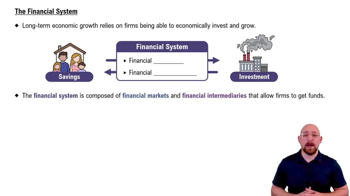
The Financial System
2
views
Terms in this set (15)
Hide definitions
Economic Investment
Allocation of resources by firms toward assets like factories or technology to boost future production.
Financial Investment
Purchase of assets such as stocks, bonds, or bank accounts, typically by households, to grow personal wealth.
Savings
Portion of income not spent on current consumption, often set aside by households for future use or investment.
Financial System
Network connecting savers and borrowers, enabling funds to flow from households to firms for investment.
Financial Market
Platform where funds move directly from savers to borrowers, often through securities like stocks or bonds.
Financial Intermediary
Institution, such as a bank or mutual fund, that channels funds from savers to borrowers indirectly.
Securities
Tradable financial assets, including stocks and bonds, used by firms to raise funds from investors.
Liquidity
Ease with which an asset can be quickly converted into cash without significant loss of value.
Diversification
Strategy of spreading investments across various assets to reduce exposure to financial risk.
Transaction Costs
Expenses incurred when buying or selling assets, which the financial system aims to minimize.
Financial Risk
Potential for loss in value of investments due to uncertainty or market fluctuations.
Interest Rate
Return earned on savings or paid on borrowed funds, often seen as a percentage of the principal.
Mutual Fund
Investment vehicle pooling money from many investors to purchase a diversified portfolio of assets.
Credit Union
Member-owned financial cooperative providing savings and loan services, acting as an intermediary.
Economic Growth
Sustained increase in a nation’s output and productive capacity over time, driven by investment.
 BackBack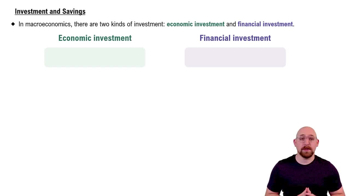
 02:01
02:01