What was the main cause of the 2007-2009 recession?
The main cause was the collapse of the real estate market, particularly due to defaults on mortgage-backed securities (MBS).
What are mortgage-backed securities (MBS)?
MBS are financial products created by bundling together various mortgages, including both low-risk and high-risk loans, and selling them as securities.
Why did investment banks suffer huge losses during the recession?
They held large amounts of MBS, which lost value rapidly as mortgage defaults increased, making the banks nearly insolvent.
What unprecedented action did the Fed take regarding discount loans during the recession?
The Fed allowed investment banks, not just commercial banks, to access discount loans for liquidity.
How did the Fed use Treasury securities to help banks during the crisis?
The Fed exchanged \$200 billion in Treasury securities for mortgage-backed securities, giving banks more reliable collateral.
Why did the Fed assist JPMorgan Chase in acquiring Bear Stearns?
The Fed wanted to prevent a financial panic and a domino effect that could worsen the recession if Bear Stearns collapsed.
What was the significance of the Fed taking control of Fannie Mae and Freddie Mac?
By taking control, the Fed aimed to stabilize the mortgage market and maintain confidence in MBS.
Why did the Fed allow Lehman Brothers to go bankrupt?
The Fed wanted to avoid creating a moral hazard, where banks might take excessive risks expecting government bailouts.
What is moral hazard in the context of the financial crisis?
Moral hazard refers to the risk that banks will make risky investments if they believe the government will bail them out without consequences.
What was the Troubled Asset Relief Program (TARP)?
TARP was a program where the government provided funds to banks in exchange for partial ownership to stabilize the financial system.
How did the Fed’s actions during the Great Recession differ from those during the Great Depression?
The Fed took more aggressive and unprecedented actions, which helped prevent the recession from lasting as long as the Great Depression.
Why were MBS considered risky investments?
They included high-risk subprime mortgages bundled with safer loans, making their true risk level hard to assess.
What role did investment banks play in the financial crisis?
Investment banks held large positions in MBS and suffered major losses when these securities lost value.
What was the intended effect of the Fed providing liquidity to investment banks?
The goal was to help banks meet short-term obligations without having to sell assets at a loss, thus stabilizing the financial system.
How did the government’s intervention through TARP represent an unprecedented action?
It involved the federal government taking ownership stakes in private banks, which was not a common practice before the crisis.
 Back
Back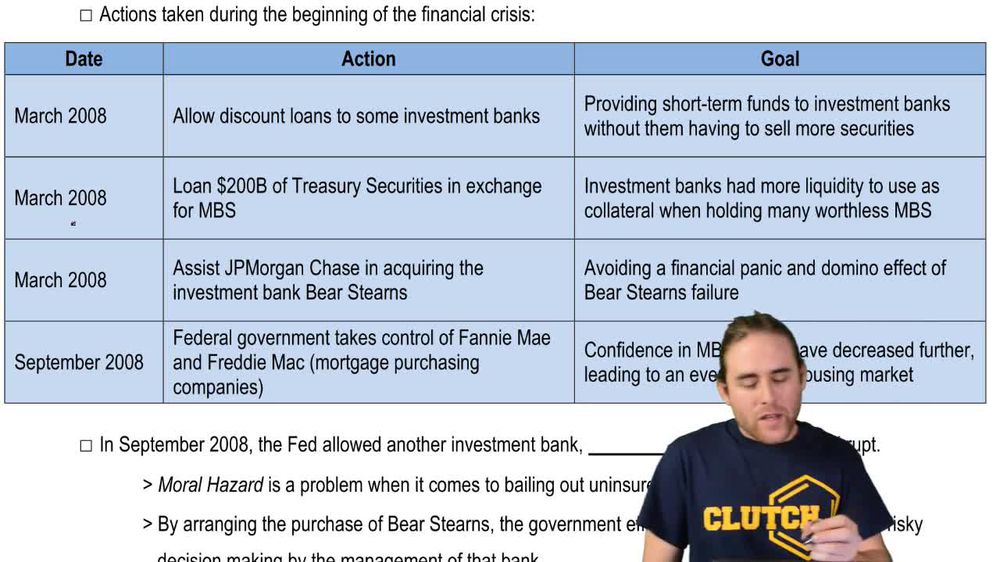
 08:06
08:06