Skip to main content
Macroeconomics
My Course
Learn
Exam Prep
AI Tutor
Study Guides
Flashcards
Explore
Try the app
My Course
Learn
Exam Prep
AI Tutor
Study Guides
Flashcards
Explore
Try the app
Back
Exchange Rates: Shifts in Supply and Demand definitions
You can tap to flip the card.
Exchange Rate
You can tap to flip the card.
👆
Exchange Rate
Price of one currency in terms of another, reflecting how much foreign currency can be obtained per unit of domestic currency.
Track progress
Control buttons has been changed to "navigation" mode.
1/15
Related flashcards
Related practice
Recommended videos
Exchange Rates: Shifts in Supply and Demand quiz
Exchange Rates: Shifts in Supply and Demand
15 Terms
22. Balance of Payments
5 topics
15 problems
Chapter
Guided course
05:01
Exchange Rates: Shifts in Supply
1
views
Guided course
06:48
Exchange Rates: Shifts in Demand
1
views
Terms in this set (15)
Hide definitions
Exchange Rate
Price of one currency in terms of another, reflecting how much foreign currency can be obtained per unit of domestic currency.
Equilibrium
Point where currency supply equals demand, determining the prevailing exchange rate in the market.
Appreciation
Increase in currency value, allowing more foreign currency to be purchased per unit of domestic currency.
Depreciation
Decrease in currency value, resulting in less foreign currency received per unit of domestic currency.
Speculation
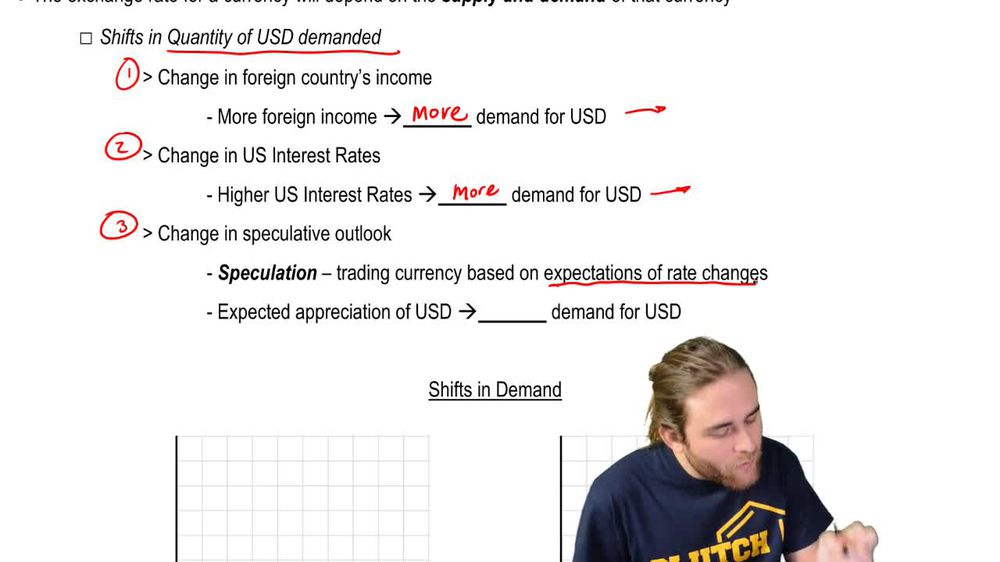
Market activity based on expectations of future currency movements, influencing immediate demand or supply.
Interest Rate
Return on investments that attracts or repels foreign capital, affecting currency demand and supply.
Foreign Income
Earnings of overseas buyers, which impact their ability to purchase domestic goods and thus affect currency demand.
US Income
Earnings within the United States, influencing the desire to import foreign goods and supply domestic currency.
Import
Purchase of foreign goods, requiring domestic currency to be exchanged and supplied in the foreign exchange market.
Export
Sale of domestic goods to foreign buyers, increasing demand for domestic currency in the exchange market.
Flexible-Exchange-Rate System
Currency valuation framework where rates adjust freely based on market supply and demand.
Aggregate Demand
Total spending on a nation's goods and services, influenced by currency value changes through trade effects.
International Trade Balance
Difference between a country's exports and imports, affected by shifts in currency value.
Determinant
Underlying factor such as income, interest rates, or expectations that causes shifts in currency supply or demand.
Quantity of US Dollars
Amount of US currency exchanged in the market, shown on the horizontal axis of exchange rate graphs.
 BackBack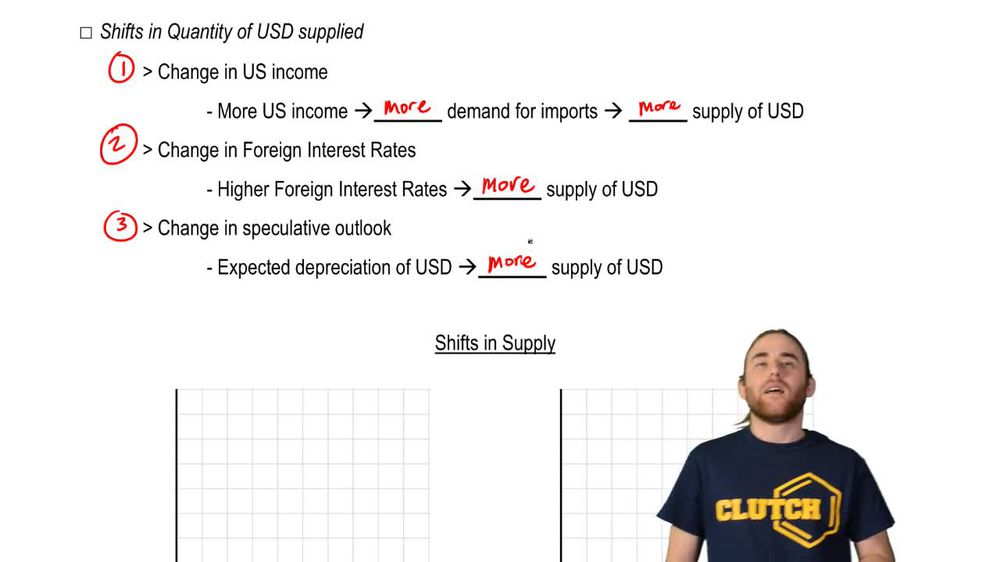
 05:01
05:01