Skip to main content
Macroeconomics
My Course
Learn
Exam Prep
AI Tutor
Study Guides
Flashcards
Explore
Try the app
My Course
Learn
Exam Prep
AI Tutor
Study Guides
Flashcards
Explore
Try the app
Back
Exchange Rates: Purchasing Power Parity quiz
You can tap to flip the card.
What does purchasing power parity (PPP) mean in the context of exchange rates?
You can tap to flip the card.
👆
What does purchasing power parity (PPP) mean in the context of exchange rates?
PPP means exchange rates equalize the purchasing power of currencies, so a unit of currency buys the same amount of goods in different countries.
Track progress
Control buttons has been changed to "navigation" mode.
1/15
Related flashcards
Related practice
Recommended videos
Exchange Rates: Purchasing Power Parity definitions
Exchange Rates: Purchasing Power Parity
15 Terms
22. Balance of Payments
5 topics
15 problems
Chapter
03:53
Purchasing Power Parity
Terms in this set (15)
Hide definitions
What does purchasing power parity (PPP) mean in the context of exchange rates?
PPP means exchange rates equalize the purchasing power of currencies, so a unit of currency buys the same amount of goods in different countries.
How can you tell if PPP holds using the price of bread in the US and Japan?
If \$1 buys one loaf of bread in the US and, after converting to yen, also buys one loaf in Japan, PPP holds.
What happens to PPP if the exchange rate changes from \(1 = 150 yen to \)1 = 300 yen, but bread prices stay the same?
PPP does not hold because \$1 now buys two loaves of bread in Japan but only one in the US.
What is the effect of exchange rate fluctuations on PPP?
Exchange rate fluctuations can cause PPP to be violated if the purchasing power of a currency differs across countries.
Why do non-traded goods prevent PPP from holding perfectly?
Non-traded goods, like restaurant meals, are not exchanged internationally, so their prices are not equalized by exchange rates.
How do trade barriers affect PPP?
Trade barriers such as tariffs or import restrictions prevent prices from equalizing across countries, disrupting PPP.
What role do differing preferences play in PPP?
If preferences for a product are higher in one country, its price may be higher there, preventing PPP.
What is the expected general trend for prices across countries according to PPP?
Prices are expected to normalize across countries unless barriers like non-traded goods or trade restrictions prevent PPP.
How does PPP relate to real exchange rates?
PPP helps analyze real exchange rates by comparing the purchasing power of currencies for a given basket of goods.
What is the impact of currency appreciation or depreciation on PPP?
Appreciation or depreciation can cause PPP to be violated if the currency's purchasing power changes unevenly across countries.
How does PPP affect aggregate demand in an open economy?
PPP influences aggregate demand by affecting the relative prices of goods and services internationally.
What is the relationship between PPP and trade balances?
PPP affects trade balances by influencing the competitiveness of domestic versus foreign goods.
Why might restaurant prices differ between the US and Europe despite exchange rates?
Restaurant meals are non-traded goods, so their prices are not equalized by exchange rates, leading to differences.
What is an example of a situation where PPP does not hold?
If \$1 buys one loaf of bread in the US but two loaves in Japan after currency conversion, PPP does not hold.
What factors can prevent PPP from being achieved in practice?
Non-traded goods, trade barriers, and differing preferences can prevent PPP from being achieved.
 BackBack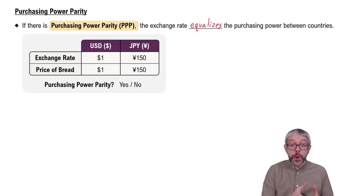
 03:53
03:53