Skip to main content
Macroeconomics
My Course
Learn
Exam Prep
AI Tutor
Study Guides
Flashcards
Explore
Try the app
My Course
Learn
Exam Prep
AI Tutor
Study Guides
Flashcards
Explore
Try the app
Back
Exchange Rates: Nominal and Real quiz
You can tap to flip the card.
What is the nominal exchange rate?
You can tap to flip the card.
👆
What is the nominal exchange rate?
The nominal exchange rate is the rate at which one currency trades for another, reflecting the current market value.
Track progress
Control buttons has been changed to "navigation" mode.
1/15
Related flashcards
Related practice
Recommended videos
Exchange Rates: Nominal and Real definitions
Exchange Rates: Nominal and Real
13 Terms
22. Balance of Payments
5 topics
15 problems
Chapter
Guided course
09:46
Nominal and Real Exchange Rates
Terms in this set (15)
Hide definitions
What is the nominal exchange rate?
The nominal exchange rate is the rate at which one currency trades for another, reflecting the current market value.
What does it mean when a currency appreciates?
Currency appreciation means your currency can buy more of the foreign currency than before.
What happens when a currency depreciates?
Currency depreciation means your currency can buy less of the foreign currency than before.
If the US dollar goes from buying 108 yen to 112 yen, what has happened to the dollar?
The US dollar has appreciated because it now buys more yen per dollar.
What is the vice versa effect in exchange rates?
When one currency appreciates, the other currency in the pair depreciates.
How does the nominal exchange rate affect international trade?
It determines how much of a foreign currency you can get for your domestic currency, impacting the cost of imports and exports.
What does the real exchange rate measure?
The real exchange rate measures the purchasing power of a currency by comparing the prices of goods between countries.
How is the real exchange rate calculated?
It is calculated as (Nominal Exchange Rate × Price Level Foreign) ÷ Price Level Domestic.
Why do we focus on goods in real exchange rate calculations?
Because the real exchange rate shows how many goods you can buy in one country compared to another, reflecting true purchasing power.
If a sandwich costs \$3 in the US and £1.5 in Britain, with an exchange rate of 0.5 pounds per dollar, what is the real exchange rate?
The real exchange rate is 1, meaning you can buy one sandwich in the US for every one sandwich in Britain.
What happens to the real exchange rate if the dollar appreciates and prices stay the same?
The real exchange rate increases, allowing you to buy more foreign goods for the same amount of domestic goods.
If the exchange rate changes from 0.5 to 0.6 pounds per dollar, what happens to the dollar?
The dollar appreciates because you get more pounds per dollar.
What does a real exchange rate of 1.2 sandwiches mean?
It means you can buy 1.2 sandwiches in Britain for every one sandwich in the US, indicating greater purchasing power abroad.
Why is it important to consider prices of goods when analyzing exchange rates?
Because even if you get more foreign currency, higher prices abroad may mean you can't buy more goods, so real purchasing power matters.
What units are left after calculating the real exchange rate?
After calculation, the units are in terms of goods, showing how many foreign goods you can buy for each domestic good.
 BackBack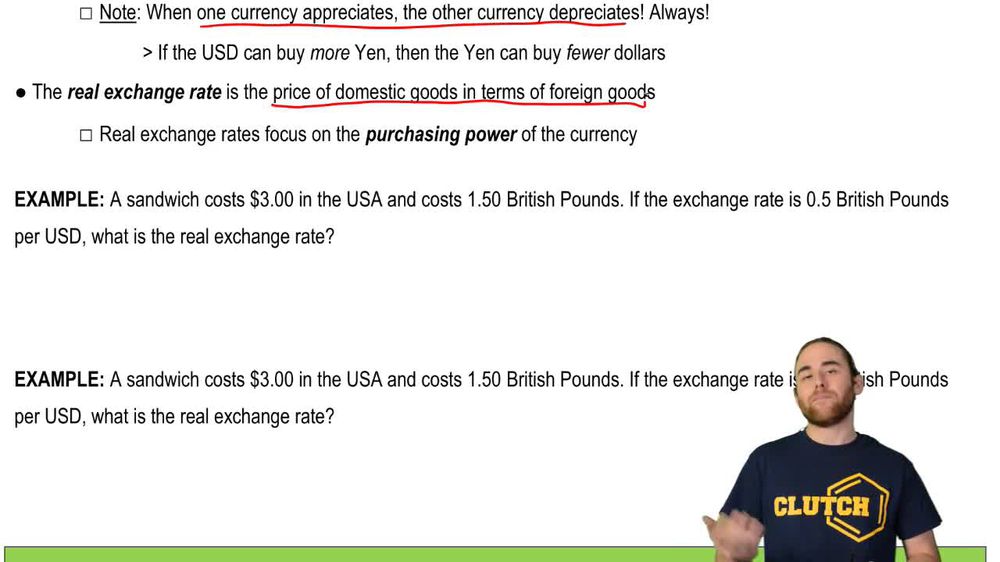
 09:46
09:46