Skip to main content
Macroeconomics
My Course
Learn
Exam Prep
AI Tutor
Study Guides
Flashcards
Explore
Try the app
My Course
Learn
Exam Prep
AI Tutor
Study Guides
Flashcards
Explore
Try the app
Back
Exchange Rates and Net Exports definitions
You can tap to flip the card.
Nominal Exchange Rate
You can tap to flip the card.
👆
Nominal Exchange Rate
The current market value at which one currency can be traded for another, often fluctuating daily in foreign exchange markets.
Track progress
Control buttons has been changed to "navigation" mode.
1/13
Related flashcards
Related practice
Recommended videos
Exchange Rates and Net Exports quiz
Exchange Rates and Net Exports
15 Terms
22. Balance of Payments
5 topics
15 problems
Chapter
Guided course
06:02
Exchange Rates and Net Exports
Terms in this set (13)
Hide definitions
Nominal Exchange Rate
The current market value at which one currency can be traded for another, often fluctuating daily in foreign exchange markets.
Currency Appreciation
A situation where a currency increases in value, allowing holders to purchase more foreign currency or goods than before.
Currency Depreciation
A decline in a currency's value, resulting in reduced purchasing power for foreign goods and increased competitiveness for exports.
Net Exports
The difference between a country's total exports and total imports, reflecting the balance of trade with other nations.
Trade Deficit
A condition where the value of imports exceeds the value of exports, often linked to a stronger domestic currency.
Trade Surplus
A scenario where exports surpass imports in value, typically associated with a weaker domestic currency.
Aggregate Demand
The total demand for goods and services within an economy, influenced by changes in exchange rates and trade balances.
Flexible-Exchange-Rate System
A system where currency values are determined by market forces, causing frequent fluctuations in exchange rates.
Imports
Goods and services purchased from foreign countries, which tend to rise when the domestic currency strengthens.
Exports
Goods and services sold to other countries, which become more competitive when the domestic currency weakens.
Balance of Payments
A record of all economic transactions between residents of a country and the rest of the world, including trade flows.
Foreign Exchange Market
A marketplace where currencies are traded, and exchange rates are determined by supply and demand.
Purchasing Power
The amount of foreign goods or currency that can be acquired with a unit of domestic currency, affected by exchange rate changes.
 BackBack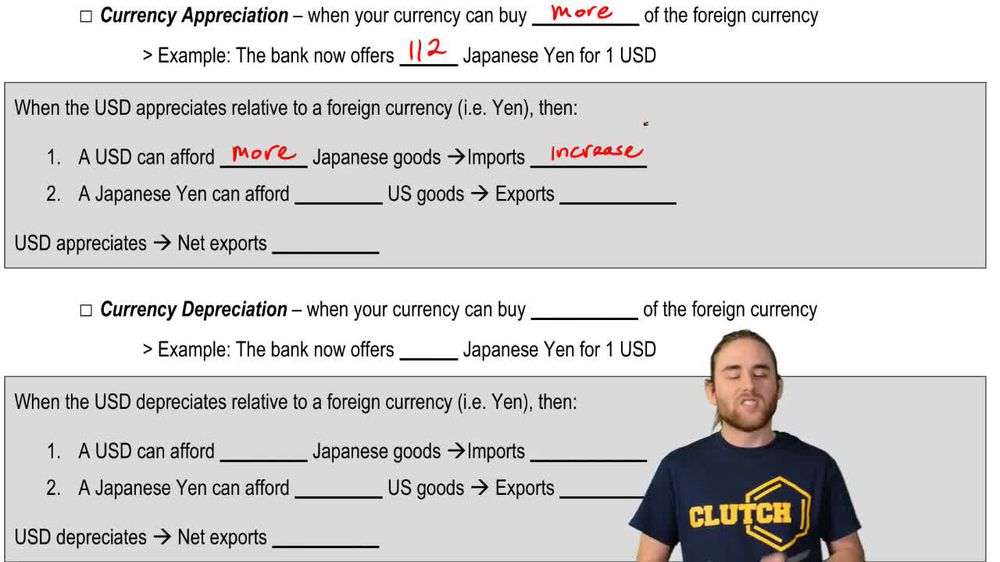
 06:02
06:02