Skip to main content
Macroeconomics
My Course
Learn
Exam Prep
AI Tutor
Study Guides
Flashcards
Explore
Try the app
My Course
Learn
Exam Prep
AI Tutor
Study Guides
Flashcards
Explore
Try the app
Back
Efficiency in Monopolistic Competition quiz
You can tap to flip the card.
What is productive efficiency in the context of market structures?
You can tap to flip the card.
👆
What is productive efficiency in the context of market structures?
Productive efficiency occurs when firms produce at the lowest possible cost, which is at the minimum point of the average total cost curve.
Track progress
Control buttons has been changed to "navigation" mode.
1/15
Related flashcards
Recommended videos
Efficiency in Monopolistic Competition definitions
Efficiency in Monopolistic Competition
15 Terms
Guided course
03:54
Monopolistic Competition Productive Efficiency
1
views
Guided course
02:56
Monopolistic Competition Allocative Efficiency
1
views
Terms in this set (15)
Hide definitions
What is productive efficiency in the context of market structures?
Productive efficiency occurs when firms produce at the lowest possible cost, which is at the minimum point of the average total cost curve.
Do monopolistically competitive firms achieve productive efficiency in the long run?
No, they do not achieve productive efficiency because they produce at a quantity before reaching the minimum average total cost.
Why do monopolistically competitive firms have excess capacity?
They have excess capacity because they produce less than the quantity that would minimize average total cost, leaving unused productive resources.
At what point do monopolistically competitive firms produce in the long run?
They produce where price equals average total cost and marginal revenue equals marginal cost, but not at the minimum average total cost.
How does perfect competition differ from monopolistic competition in terms of productive efficiency?
Perfect competition forces firms to produce at the minimum average total cost, achieving productive efficiency, unlike monopolistic competition.
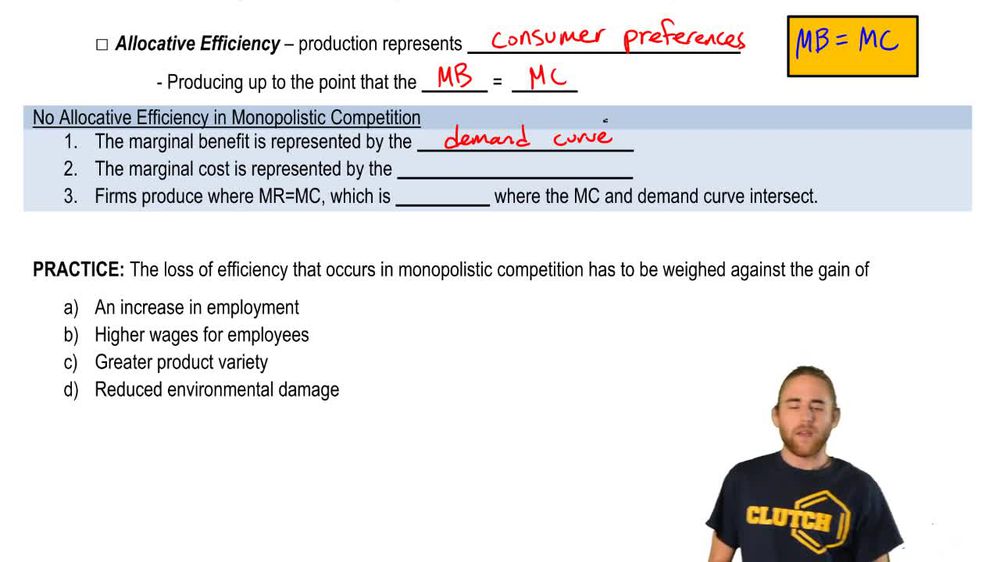
What is allocative efficiency?
Allocative efficiency is achieved when production reflects consumer preferences, specifically where marginal benefit equals marginal cost.
Where is the allocatively efficient quantity found on a graph?
It is found where the demand curve (marginal benefit) intersects the marginal cost curve.
Do monopolistically competitive firms achieve allocative efficiency?
No, they do not, because they produce where marginal revenue equals marginal cost, not where demand equals marginal cost.
Why do monopolistically competitive firms not produce the socially optimal quantity?
They produce less than the socially optimal quantity, where consumers' marginal benefit would equal producers' marginal cost.
What does it mean if the marginal benefit to consumers is greater than the marginal cost to producers at the profit-maximizing quantity?
It means that more units should be produced to achieve allocative efficiency, but monopolistically competitive firms do not do this.
What is the profit-maximizing rule for monopolistically competitive firms?
They maximize profit by producing where marginal revenue equals marginal cost.
How does the demand curve relate to marginal benefit in monopolistic competition?
The demand curve represents the marginal benefit to consumers.
What is the main source of inefficiency in monopolistic competition compared to perfect competition?
The main source is that firms do not produce at the minimum average total cost nor at the quantity where marginal benefit equals marginal cost.
What happens to average total cost if a monopolistically competitive firm increases output beyond its current level?
Average total cost would decrease, indicating the firm is not at productive efficiency.
Why is understanding inefficiency in monopolistic competition important?
It helps analyze market outcomes and the impact of firm behavior in imperfect competition.
 BackBack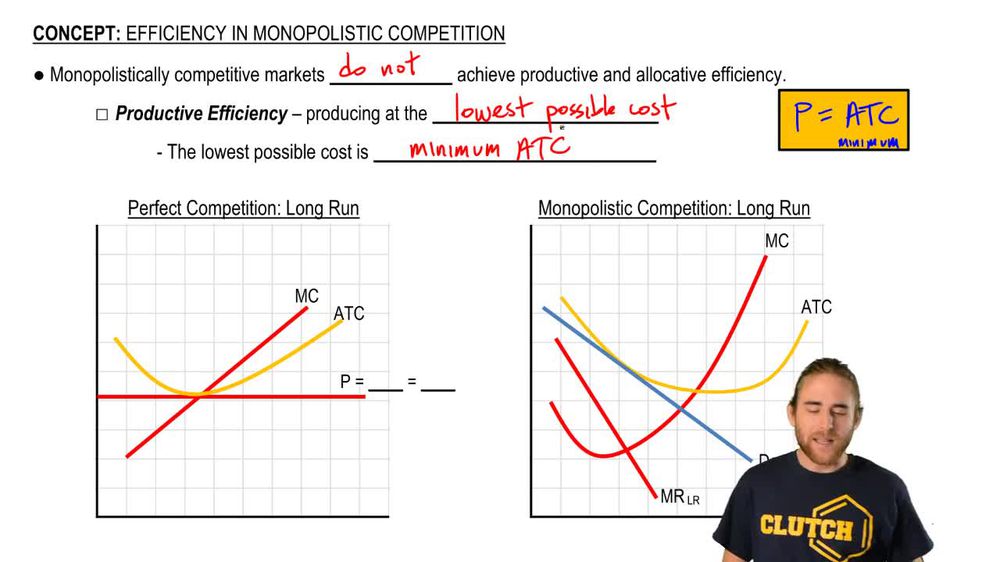
 03:54
03:54