Skip to main content
Macroeconomics
My Course
Learn
Exam Prep
AI Tutor
Study Guides
Flashcards
Explore
Try the app
My Course
Learn
Exam Prep
AI Tutor
Study Guides
Flashcards
Explore
Try the app
Back
Dynamic AD-AS Model: Inflation and Recession quiz
You can tap to flip the card.
What causes inflation in the dynamic AD-AS model?
You can tap to flip the card.
👆
What causes inflation in the dynamic AD-AS model?
Inflation occurs when aggregate demand increases faster than aggregate supply, leading to rising prices as demand outstrips supply.
Track progress
Control buttons has been changed to "navigation" mode.
1/15
Related flashcards
Related practice
Recommended videos
Dynamic AD-AS Model: Inflation and Recession definitions
Dynamic AD-AS Model: Inflation and Recession
15 Terms
Dynamic AD-AS Model: Inflation and Recession
23. Dynamic AD/AS Model
10 problems
Topic
Dynamic AD-AS Model: Fiscal Policy
23. Dynamic AD/AS Model
10 problems
Topic
25. Dynamic AD/AS Model
4 topics
15 problems
Chapter
Guided course
06:30
Dynamic AD-AS Model: Recession
4
views
Guided course
04:05
Dynamic AD-AS Model: Inflation
2
views
Terms in this set (15)
Hide definitions
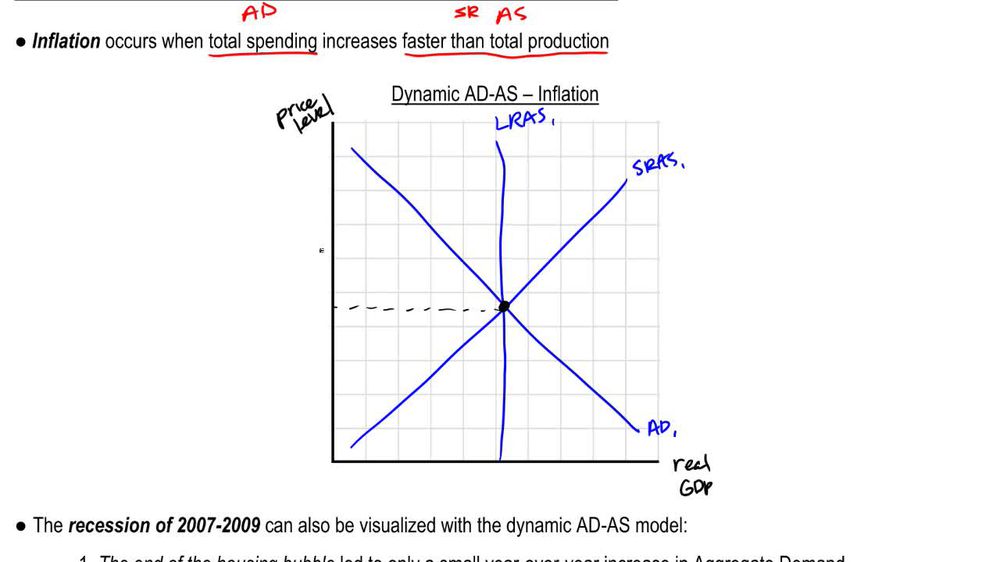
What causes inflation in the dynamic AD-AS model?
Inflation occurs when aggregate demand increases faster than aggregate supply, leading to rising prices as demand outstrips supply.
How does the aggregate demand curve shift during inflation in the dynamic AD-AS model?
The aggregate demand curve shifts significantly to the right, more than the short-run aggregate supply curve.
What happens to the price level and GDP when aggregate demand shifts more than short-run aggregate supply?
The price level increases and GDP also rises, resulting in inflation.
In the dynamic AD-AS model, what is the main factor leading to higher price levels during inflation?
A larger rightward shift in aggregate demand compared to the short-run aggregate supply causes higher price levels.
What is the effect of a small shift in short-run aggregate supply compared to a large shift in aggregate demand?
It results in inflation, with both higher prices and increased GDP.
What are the axes on the dynamic AD-AS model graph?
The y-axis represents the price level, and the x-axis represents real GDP.
What three curves are used in the dynamic AD-AS model?
The model uses the aggregate demand curve, short-run aggregate supply curve, and long-run aggregate supply curve.
What major event contributed to the 2007-2009 recession in the dynamic AD-AS model?
The end of the housing bubble, which led to a small increase in aggregate demand.
How did the financial crisis during the 2007-2009 recession affect aggregate demand?
It limited credit availability, causing aggregate demand to shift only slightly to the right.
What supply shock occurred during the 2007-2009 recession, and how did it affect the model?
Rising oil prices caused a large leftward shift in short-run aggregate supply.
How does a supply shock affect short-run and long-run aggregate supply in the dynamic AD-AS model?
A supply shock affects only the short-run aggregate supply, not the long-run aggregate supply.
What happens to equilibrium in the dynamic AD-AS model during a recession?
The new equilibrium shows higher prices and lower GDP compared to the previous year.
How is the 2007-2009 recession represented graphically in the dynamic AD-AS model?
Aggregate demand shifts slightly right, while short-run aggregate supply shifts significantly left, resulting in higher prices and lower GDP.
Why does long-run aggregate supply continue to increase even during a recession?
Long-run aggregate supply increases due to factors like technology and labor force growth, reflecting rising potential GDP.
Where is the short-run equilibrium found in the dynamic AD-AS model during a recession?
It is at the intersection of the new aggregate demand and short-run aggregate supply curves, showing the effects of the recession.
 BackBack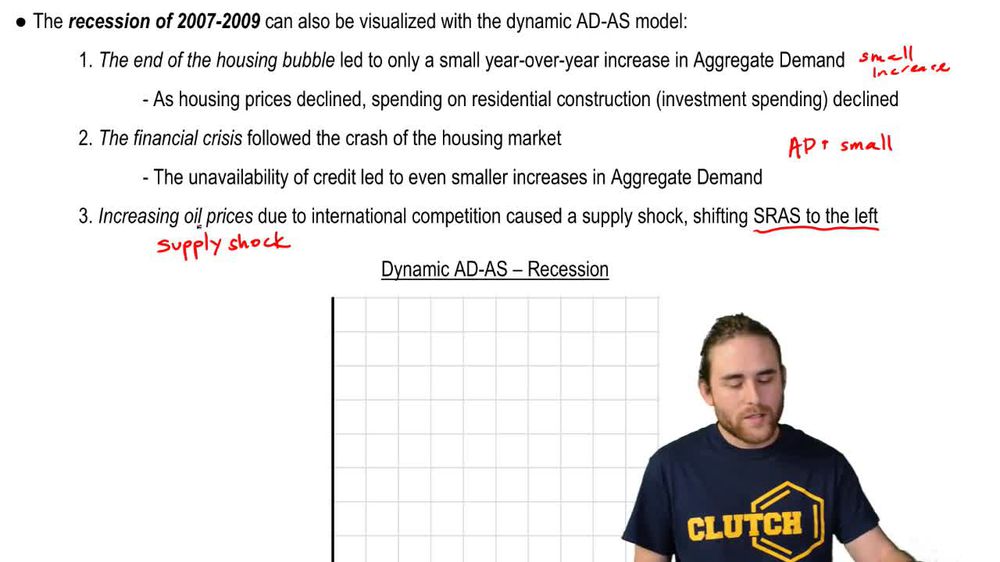
 06:30
06:30