Skip to main content
Macroeconomics
My Course
Learn
Exam Prep
AI Tutor
Study Guides
Flashcards
Explore
Try the app
My Course
Learn
Exam Prep
AI Tutor
Study Guides
Flashcards
Explore
Try the app
Back
Determinants of Price Elasticity of Demand quiz
You can tap to flip the card.
What is the most important determinant of price elasticity of demand?
You can tap to flip the card.
👆
What is the most important determinant of price elasticity of demand?
The availability of close substitutes is the most important determinant; products with many substitutes have more elastic demand.
Track progress
Control buttons has been changed to "navigation" mode.
1/15
Related flashcards
Related practice
Recommended videos
Determinants of Price Elasticity of Demand definitions
Determinants of Price Elasticity of Demand
13 Terms
Determinants of Price Elasticity of Demand
4. Elasticity
10 problems
Topic
Total Revenue Test
4. Elasticity
10 problems
Topic
4. Elasticity - Part 1 of 2
10 topics
15 problems
Chapter
4. Elasticity - Part 2 of 2
1 topic
3 problems
Chapter
Guided course
06:12
Determinants of Price Elasticity of Demand
8
views
Terms in this set (15)
Hide definitions
What is the most important determinant of price elasticity of demand?
The availability of close substitutes is the most important determinant; products with many substitutes have more elastic demand.
How does the presence of close substitutes affect price elasticity of demand?
When there are many close substitutes, demand is more elastic because consumers can easily switch to other products if the price rises.
Why are utilities like electricity generally inelastic in demand?
Utilities have few or no close substitutes, so consumers cannot easily switch, making demand less elastic.
How does the necessity of a product influence its price elasticity of demand?
Necessities tend to have inelastic demand because consumers will buy them regardless of price changes.
Why do luxury items tend to have more elastic demand?
Luxury items are not essential, so consumers are more likely to reduce their purchases if prices rise, making demand more elastic.
How does defining a market narrowly affect price elasticity of demand?
Narrow market definitions, like apples instead of fruit, result in more elastic demand because substitutes are more apparent.
What happens to price elasticity when the market is defined broadly?
Broad market definitions, such as fruit, tend to have less elastic demand because substitutes within the category are less relevant.
How does time affect the price elasticity of demand?
In the short run, demand is often inelastic due to limited alternatives, but in the long run, demand becomes more elastic as consumers adapt.
Why is demand for gasoline more inelastic in the short run?
Consumers are dependent on gasoline and cannot quickly change their consumption habits, making demand inelastic in the short run.
How can consumers make demand for gasoline more elastic in the long run?
Over time, consumers can switch to alternatives like hybrids or public transport, increasing the elasticity of demand for gasoline.
How does the share of a consumer's budget spent on a product affect its price elasticity?
Products that take up a large share of a consumer's budget have more elastic demand because price changes significantly impact purchasing decisions.
Why is demand for inexpensive items like gum generally inelastic?
Since gum is a small part of a consumer's budget, price changes have little effect on demand, making it inelastic.
How does a price increase for a house affect demand compared to a price increase for gum?
A price increase for a house, which is a large budget item, makes demand more elastic, while a price increase for gum has little effect on demand.
What is the relationship between the number of substitutes and the elasticity of demand?
The more substitutes available, the more elastic the demand for a product.
Summarize the main determinants of price elasticity of demand.
The main determinants are availability of substitutes, necessity vs. luxury, market definition, time horizon, and share of budget.
 BackBack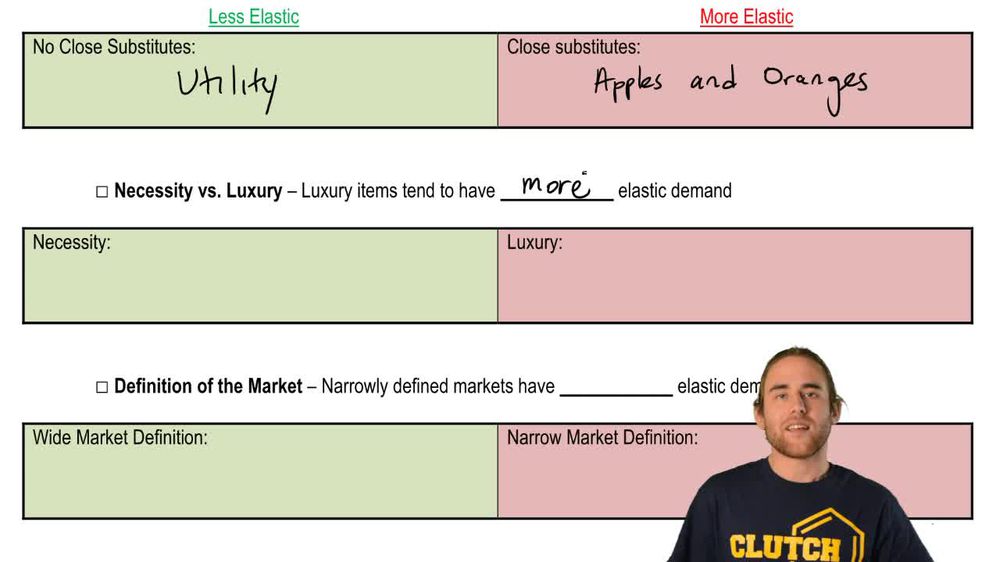
 06:12
06:12