What causes the consumption function to shift up or down?
Factors other than changes in disposable income, such as changes in wealth, borrowing, expectations, and real interest rates, cause the consumption function to shift.
How does a sudden increase in wealth affect the consumption function?
A sudden increase in wealth, like rising stock prices, shifts the consumption function upward, leading to increased consumption.
What happens to consumption when there is an unexpected decrease in wealth?
An unexpected decrease in wealth, such as a real estate crash, shifts the consumption function downward, resulting in decreased consumption.
How does borrowing money impact current and future consumption?
Borrowing increases current consumption but decreases future consumption due to the need to repay the loan with interest.
Why does borrowing lead to decreased future consumption?
Because the interest cost of borrowing reduces future wealth, requiring lower consumption later to repay the loan.
How do expectations about future prices influence current consumption?
If people expect prices to rise in the future, they increase current consumption to buy at lower prices.
What effect does expecting higher future income have on current consumption?
Expecting higher future income leads to increased current consumption, as people anticipate having more money later.
How does the expectation of a recession affect current consumption and saving?
Expecting a recession causes people to decrease current consumption and increase saving to prepare for tougher times.
What is the marginal propensity to consume in the context of the consumption function?
It is the slope of the consumption function, showing how much consumption changes with a change in disposable income.
How do low real interest rates affect borrowing and consumption?
Low real interest rates encourage more borrowing and spending, increasing current consumption.
Why do low real interest rates reduce the incentive to save?
Because saving yields less return, people are less motivated to save and more likely to spend.
What types of goods are often purchased with credit when interest rates are low?
Goods like cars and other big-ticket items are often purchased with credit when borrowing costs are low.
How is the consumption function similar to supply and demand curves?
Like supply and demand curves, the consumption function can shift due to factors other than its main variable (disposable income).
What role does wealth play in determining consumption and saving?
Changes in wealth directly affect consumption and saving, with increased wealth leading to more consumption and decreased wealth leading to less.
What logical pattern do most determinants of consumption and saving follow?
Most determinants follow intuitive logic: positive changes (like wealth or income) increase consumption, while negative changes (like recession expectations) decrease it.
 Back
Back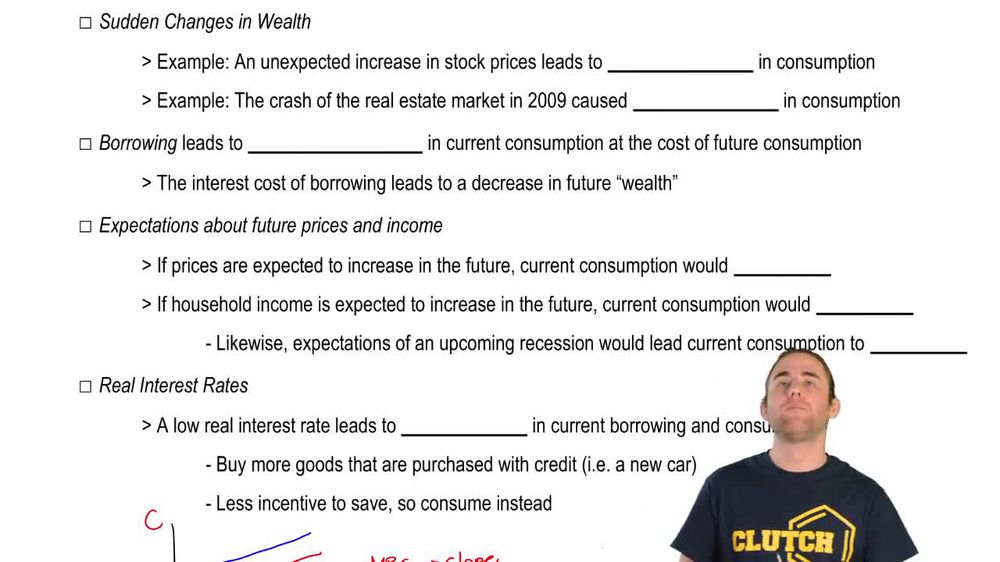
 05:13
05:13