Skip to main content
Macroeconomics
My Course
Learn
Exam Prep
AI Tutor
Study Guides
Flashcards
Explore
Try the app
My Course
Learn
Exam Prep
AI Tutor
Study Guides
Flashcards
Explore
Try the app
Back
Detailed Explanation of GDP Components definitions
You can tap to flip the card.
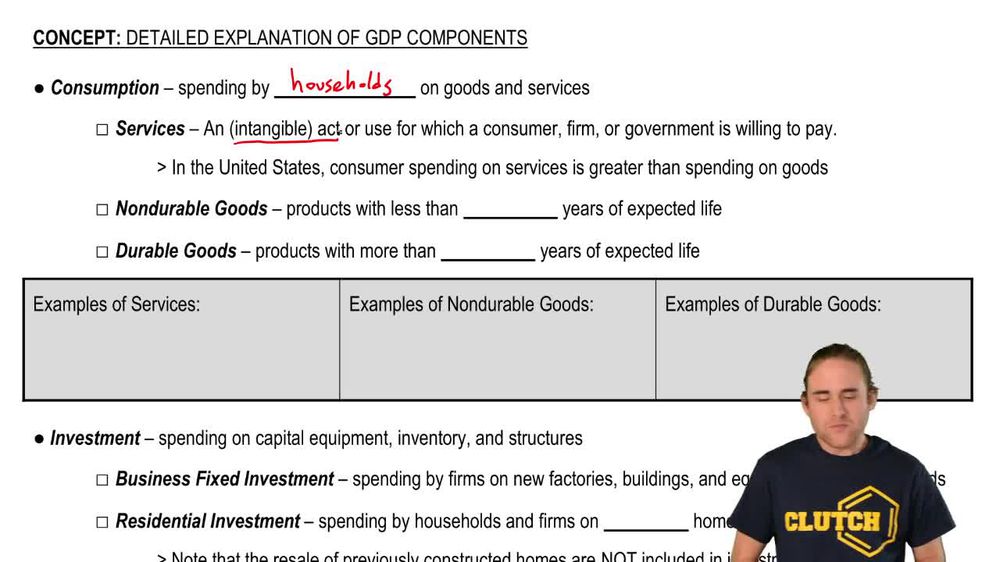
Consumption
You can tap to flip the card.
👆
Consumption
Household spending on goods and services, divided into services, nondurable goods, and durable goods.
Track progress
Control buttons has been changed to "navigation" mode.
1/14
Related flashcards
Related practice
Recommended videos
Detailed Explanation of GDP Components quiz #1
Detailed Explanation of GDP Components
10 Terms
Detailed Explanation of GDP Components
10. Measuring National Output and Income
10 problems
Topic
Nominal GDP and Real GDP
10. Measuring National Output and Income
10 problems
Topic
11. Gross Domestic Product (GDP) and Consumer Price Index (CPI)
7 topics
10 problems
Chapter
Guided course
02:12
Government Purchases and Net Exports
4
views
Guided course
02:38
Consumption
7
views
02:01
Investment
2
views
Terms in this set (14)
Hide definitions
Consumption
Household spending on goods and services, divided into services, nondurable goods, and durable goods.
Services
Intangible acts purchased by consumers, such as haircuts or legal advice, with no physical product exchanged.
Nondurable Goods
Tangible items with less than three years of expected life, like food or shoes, purchased by households.
Durable Goods
Tangible items with more than three years of expected life, such as cars or washing machines, bought by households.
Investment
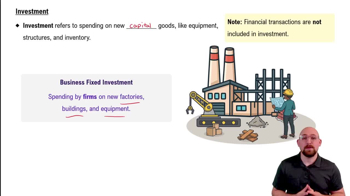
Spending on new capital goods, including equipment, structures, and inventory, excluding financial assets.
Business Fixed Investment
Firm spending on long-term physical assets like factories, buildings, or equipment for production.
Residential Investment
Expenditure on new home construction by households or firms, including major renovations.
Inventory Change
Difference between beginning and ending stock of unsold goods, which can be positive or negative.
Government Purchases
Spending by local, state, and federal governments on goods and services, excluding transfer payments.
Transfer Payments
Government payments like welfare or unemployment checks, not counted in GDP until spent by households.
Net Exports
Value of exports minus imports; can be positive or negative, indicating trade surplus or deficit.
Exports
Goods produced domestically and sold to buyers in other countries, contributing positively to GDP.
Imports
Goods produced abroad and purchased domestically, subtracted from GDP calculation.
Expenditure Approach
Method for calculating GDP by summing consumption, investment, government purchases, and net exports.
 BackBack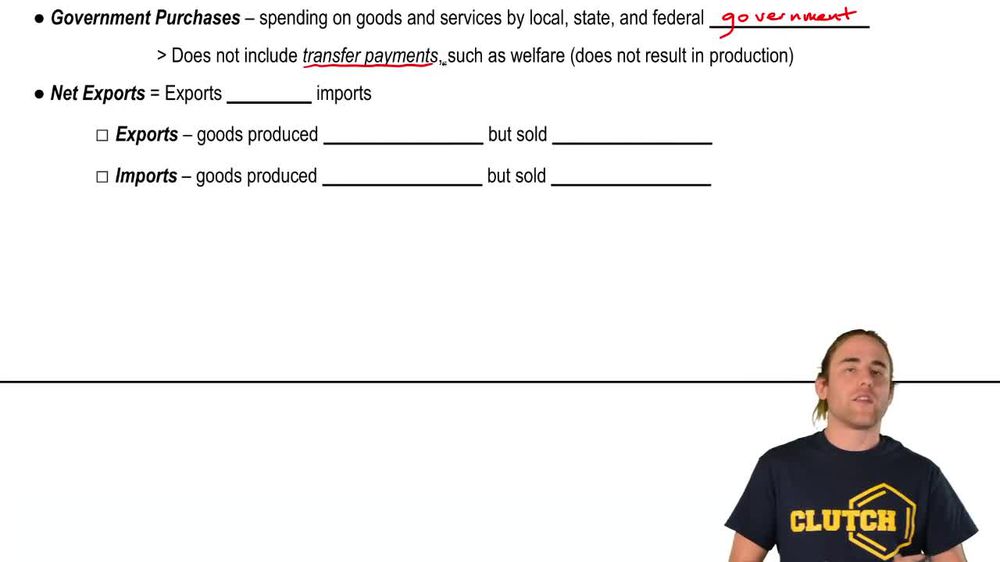
 02:12
02:12