Skip to main content
Macroeconomics
My Course
Learn
Exam Prep
AI Tutor
Study Guides
Flashcards
Explore
Try the app
My Course
Learn
Exam Prep
AI Tutor
Study Guides
Flashcards
Explore
Try the app
Back
Demand for Labor in Perfect Competition definitions
You can tap to flip the card.
Derived Demand
You can tap to flip the card.
👆
Derived Demand
Occurs when the need for a resource depends on the demand for the final good it helps produce.
Track progress
Control buttons has been changed to "navigation" mode.
1/13
Related flashcards
Recommended videos
Demand for Labor in Perfect Competition quiz
Demand for Labor in Perfect Competition
15 Terms
Guided course
04:33
Demand for Labor in Perfect Competition
Terms in this set (13)
Hide definitions
Derived Demand
Occurs when the need for a resource depends on the demand for the final good it helps produce.
Labor Market
A setting where firms seek workers and individuals offer their work, determining employment and wage outcomes.
Equilibrium Wage
The pay rate where the number of workers firms want equals the number of workers willing to work.
Wage
The monetary compensation paid to workers, acting as the price for their labor in the market.
Labor Supply
The total amount of work effort individuals are willing to offer at various wage levels.
Labor Demand
The quantity of workers firms wish to hire at different wage rates, shaped by productivity and product demand.
Marginal Revenue Product
The extra income a firm gains from hiring one more worker, guiding how many workers to employ.
Production Function
A relationship showing how inputs like labor are transformed into outputs by a firm.
Equilibrium Quantity
The number of workers employed where labor supply meets labor demand in the market.
Price of Labor
The cost to firms for employing workers, typically reflected as the wage rate.
Product Market
A marketplace where final goods are bought and sold, influencing the need for labor.
Quantity of Workers
The total number of employees hired by firms at a given wage.
Value of Marginal Product
Another term for the additional revenue generated by employing one more unit of labor.
 BackBack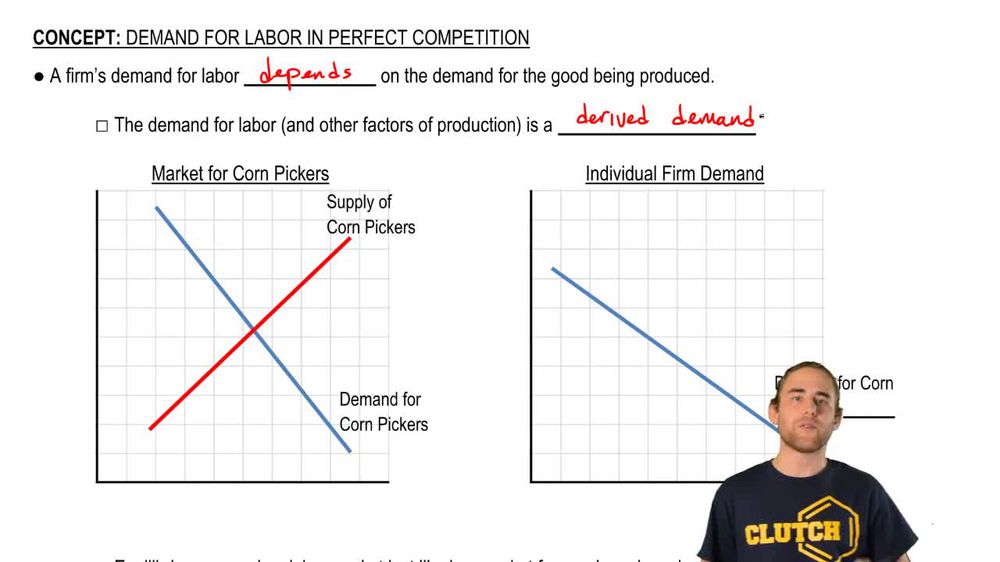
 04:33
04:33