Skip to main content
Macroeconomics
My Course
Learn
Exam Prep
AI Tutor
Study Guides
Flashcards
Explore
Try the app
My Course
Learn
Exam Prep
AI Tutor
Study Guides
Flashcards
Explore
Try the app
Back
Defining the Money Supply: M1 and M2 definitions
You can tap to flip the card.
Money Supply
You can tap to flip the card.
👆
Money Supply
Total amount of monetary assets available in an economy, categorized by liquidity for economic analysis.
Track progress
Control buttons has been changed to "navigation" mode.
1/12
Related flashcards
Related practice
Recommended videos
Defining the Money Supply: M1 and M2 quiz #1
Defining the Money Supply: M1 and M2
10 Terms
Defining the Money Supply: M1 and M2
17. The Monetary System
10 problems
Topic
Required Reserves and the Deposit Multiplier
17. The Monetary System
10 problems
Topic
18. The Monetary System
7 topics
15 problems
Chapter
02:14
Defining the Money Supply: M1 and M2
1
views
Terms in this set (12)
Hide definitions
Money Supply
Total amount of monetary assets available in an economy, categorized by liquidity for economic analysis.
M1
Category including the most liquid assets, such as cash, demand deposits, and savings, easily used for transactions.
M2
Broader measure that includes M1 plus less liquid assets like money market funds and certificates of deposit.
Liquidity
Degree to which an asset can be quickly converted into cash for spending without significant loss of value.
Currency
Physical cash, such as coins and bills, immediately available for transactions and purchases.
Demand Deposits
Bank account balances, accessible via checks or debit cards, that can be withdrawn on demand for spending.
Savings
Bank accounts offering quick access to funds, now considered highly liquid due to online banking advancements.
Money Market Funds
Investment vehicles holding short-term debt, requiring a waiting period before funds become available as cash.
Certificates of Deposit
Time-bound savings instruments with fixed maturity dates, restricting immediate access to deposited funds.
Monetary Aggregates
Grouped measures of money supply, such as M1 and M2, used to assess economic liquidity and policy impacts.
Monetary Base
Foundation of an economy's money supply, including currency in circulation and reserves held by banks.
Online Banking
Digital platform enabling rapid transfers and access to funds, increasing the liquidity of savings accounts.
 BackBack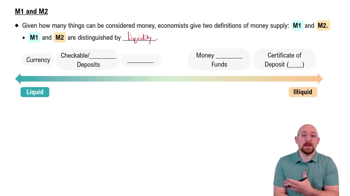
 02:14
02:14