What does cross price elasticity of demand measure?
It measures how the quantity demanded of one good responds to a change in the price of another good.
What is always in the numerator of the cross price elasticity formula?
The quantity demanded of one good is always in the numerator.
What is in the denominator of the cross price elasticity formula?
The price of a different good (not the one whose quantity is measured) is in the denominator.
What calculation method is used for cross price elasticity?
The midpoint method is used, similar to other elasticity calculations.
What does a positive cross price elasticity indicate about two goods?
A positive value indicates the goods are substitutes.
What does a negative cross price elasticity indicate about two goods?
A negative value indicates the goods are complements.
What does a cross price elasticity of zero indicate?
It indicates the goods are unrelated.
If the price of tennis rackets increases and the demand for tennis balls decreases, what is the relationship between the goods?
They are complements, as shown by the negative cross price elasticity.
How do you calculate the percentage change in quantity demanded using the midpoint method?
Subtract the old quantity from the new, divide by the average of the two quantities.
How do you calculate the percentage change in price using the midpoint method?
Subtract the old price from the new, divide by the average of the two prices.
What is the formula for cross price elasticity of demand?
It is the percentage change in quantity demanded of one good divided by the percentage change in price of another good.
In the example, what was the cross price elasticity when the price of tennis rackets increased from \$45 to \$55 and tennis balls demand dropped from 21,000 to 19,000?
The cross price elasticity was -0.5.
What does the sign (positive or negative) of the cross price elasticity tell us?
It tells us whether the goods are substitutes (positive), complements (negative), or unrelated (zero).
If the price of one good goes up and the quantity demanded of another good also goes up, what is their relationship?
They are substitutes, as indicated by a positive cross price elasticity.
Why can you sometimes determine the relationship between goods without doing the math?
Because the direction of changes in price and quantity demanded can logically indicate whether goods are substitutes or complements.
 Back
Back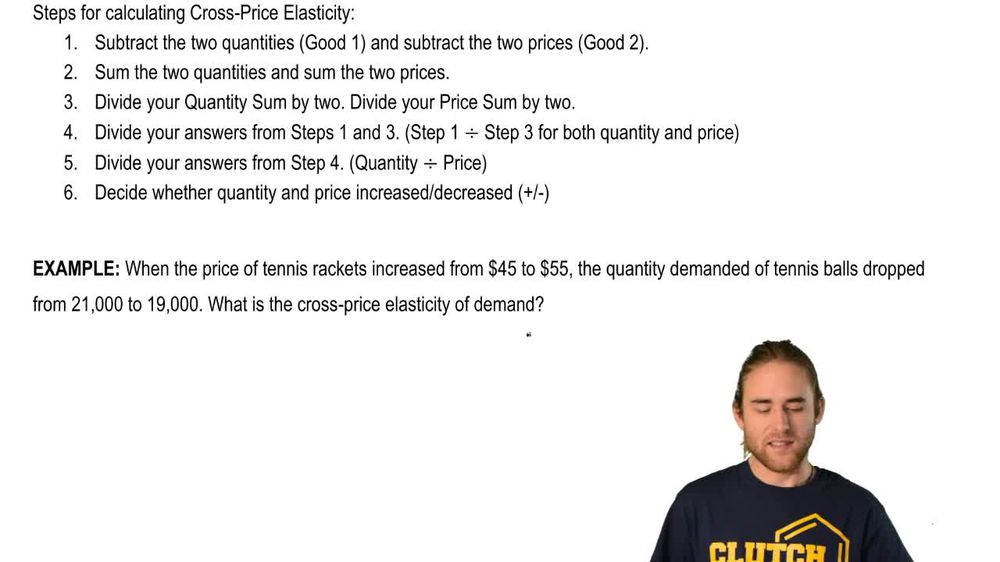
 07:14
07:14