Skip to main content
Macroeconomics
My Course
Learn
Exam Prep
AI Tutor
Study Guides
Flashcards
Explore
Try the app
My Course
Learn
Exam Prep
AI Tutor
Study Guides
Flashcards
Explore
Try the app
Back
Costs of Inflation: Shoe-leather Costs and Menu Costs definitions
You can tap to flip the card.
Shoe Leather Cost
You can tap to flip the card.
👆
Shoe Leather Cost
Resources and time wasted making frequent bank trips to avoid holding cash that loses value during periods of rising prices.
Track progress
Control buttons has been changed to "navigation" mode.
1/12
Related flashcards
Related practice
Recommended videos
Costs of Inflation: Shoe-leather Costs and Menu Costs quiz #1
Costs of Inflation: Shoe-leather Costs and Menu Costs
17 Terms
Costs of Inflation: Shoe-leather Costs and Menu Costs
11. Unemployment and Inflation
10 problems
Topic
Demand-Pull and Cost-Push Inflation
11. Unemployment and Inflation
10 problems
Topic
12. Unemployment and Inflation
8 topics
11 problems
Chapter
Guided course
04:37
Costs of Inflation: Shoe-leather Costs, Menu Costs, and Tax Costs
3
views
Terms in this set (12)
Hide definitions
Shoe Leather Cost
Resources and time wasted making frequent bank trips to avoid holding cash that loses value during periods of rising prices.
Menu Cost
Expenses businesses face from frequently updating prices, such as printing new menus or price tags, due to ongoing inflation.
Tax Cost
Financial burden from being taxed on nominal gains caused by inflation, even when real purchasing power remains unchanged.
Hyperinflation
Extremely rapid price increases, typically above 50% annually, causing severe economic disruptions and escalating inflation-related costs.
Nominal Value
Stated monetary amount of an asset, unadjusted for changes in purchasing power due to inflation.
Purchasing Power
Ability of money to buy goods and services, which diminishes as prices rise during inflation.
Phantom Income
Apparent profit resulting from inflation-driven asset value increases, not reflecting actual gains in real terms.
Banking Transaction
Action of depositing or withdrawing funds, which becomes more frequent as individuals try to minimize cash holdings during inflation.
Price Tag
Physical or digital label showing the cost of an item, which must be updated more often when inflation is high.
Interest
Earnings from keeping money in a bank, motivating people to deposit cash rather than hold it during inflation.
Societal Cost
Overall inefficiency and inconvenience experienced by a community as a result of inflation, even when anticipated.
Economic Disruption
Disturbance in normal market activities, often intensified by rapid and unpredictable price increases.
 BackBack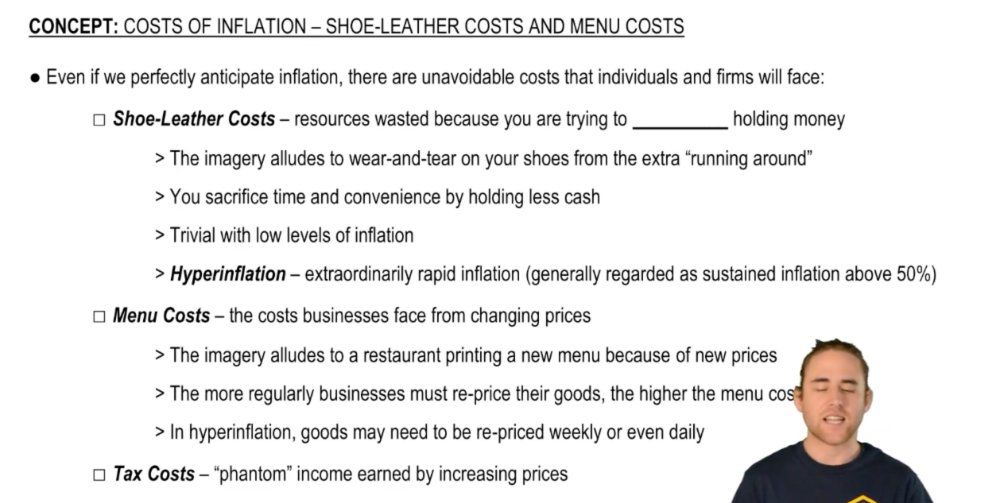
 04:37
04:37