Skip to main content
Macroeconomics
My Course
Learn
Exam Prep
AI Tutor
Study Guides
Flashcards
Explore
Try the app
My Course
Learn
Exam Prep
AI Tutor
Study Guides
Flashcards
Explore
Try the app
Back
Cost-Minimizing Combination of Labor and Capital definitions
You can tap to flip the card.
Isoquant Curve
You can tap to flip the card.
👆
Isoquant Curve
A graphical representation showing all input combinations that yield the same output level, typically curved to reflect input trade-offs.
Track progress
Control buttons has been changed to "navigation" mode.
1/15
Related flashcards
Recommended videos
Cost-Minimizing Combination of Labor and Capital quiz
Cost-Minimizing Combination of Labor and Capital
15 Terms
Guided course
05:02
Cost Minimizing Combination of Labor and Capital
1
views
Guided course
01:45
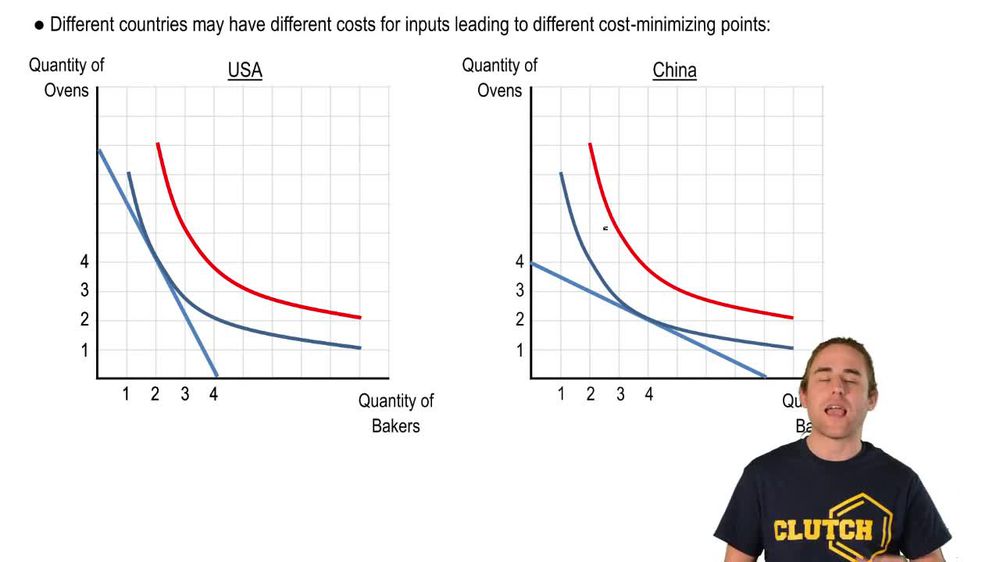
Differences in Cost Minimizing Point
1
views
Terms in this set (15)
Hide definitions
Isoquant Curve
A graphical representation showing all input combinations that yield the same output level, typically curved to reflect input trade-offs.
Isocost Line
A straight line depicting all possible input combinations that can be purchased for a given total cost, based on input prices.
Cost Minimization
The process of selecting input combinations that achieve a specific output at the lowest possible expense.
Tangent Point
The unique spot where an isoquant curve just touches an isocost line, indicating the optimal input mix.
Input Combination
A specific mix of resources, such as labor and capital, used together to produce a certain output.
Capital-Labor Ratio
The proportion of capital to labor used in production, influencing the cost structure and efficiency.
Budget Constraint
A limit on the total spending available for inputs, shaping the feasible set of input combinations.
Comparative Advantage
A situation where a country or producer can produce a good at a lower opportunity cost due to input price differences.
Input Price
The cost associated with acquiring a unit of a production resource, such as labor or capital.
Production Efficiency
A state where output is maximized for a given cost, with no resources wasted in the input mix.
Aggregate Supply
The total quantity of goods and services that producers in an economy are willing to supply at various price levels.
Output Level
A specific quantity of goods produced, often used as a target for cost minimization analysis.
Origin
The point on a graph where both input quantities are zero, serving as a reference for isocost and isoquant positioning.
Total Cost
The overall expenditure required to purchase all inputs needed for a certain level of production.
Resource Allocation
The distribution of available inputs among different uses to achieve production goals efficiently.
 BackBack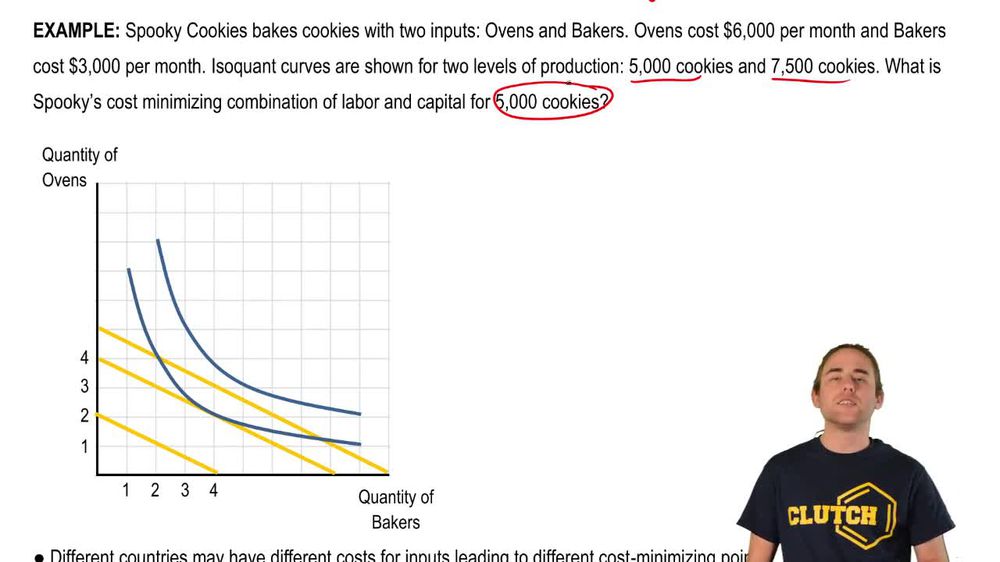
 05:02
05:02