Skip to main content
Macroeconomics
My Course
Learn
Exam Prep
AI Tutor
Study Guides
Flashcards
Explore
Try the app
My Course
Learn
Exam Prep
AI Tutor
Study Guides
Flashcards
Explore
Try the app
Back
Consumer Optimum Consumption: Marginal Utility per Dollar Spent definitions
You can tap to flip the card.
Optimum Consumption
You can tap to flip the card.
👆
Optimum Consumption
A combination of goods that yields the highest satisfaction possible given a consumer's income and prices of goods.
Track progress
Control buttons has been changed to "navigation" mode.
1/14
Related flashcards
Recommended videos
Consumer Optimum Consumption: Marginal Utility per Dollar Spent quiz
Consumer Optimum Consumption: Marginal Utility per Dollar Spent
15 Terms
Guided course
09:38
Consumer Optimum Consumption: Marginal Utility per Dollar Spent
Terms in this set (14)
Hide definitions
Optimum Consumption
A combination of goods that yields the highest satisfaction possible given a consumer's income and prices of goods.
Utility
A measure of satisfaction or happiness derived from consuming goods or services.
Marginal Utility
The additional satisfaction gained from consuming one more unit of a good or service.
Budget Constraint
A limit on spending based on income and the prices of goods, restricting possible consumption choices.
Marginal Utility per Dollar
The extra satisfaction received from spending one more dollar on a good, calculated by dividing marginal utility by price.
Diminishing Marginal Utility
A principle stating that each additional unit of a good provides less added satisfaction than the previous one.
Consumption Bundle
A specific combination of quantities of different goods purchased within a budget.
Income
The total amount of money available to a consumer for spending on goods and services.
Price
The amount of money required to purchase one unit of a good or service.
Satisfaction
The sense of fulfillment or pleasure obtained from consuming goods or services.
Resource Allocation
The process of distributing limited income among various goods to maximize overall satisfaction.
Equalization Rule
A guideline stating that utility is maximized when the marginal utility per dollar is the same for all goods.
Total Utility
The overall satisfaction accumulated from consuming a certain quantity of goods.
Affordability
The ability to purchase a combination of goods without exceeding available income.
 BackBack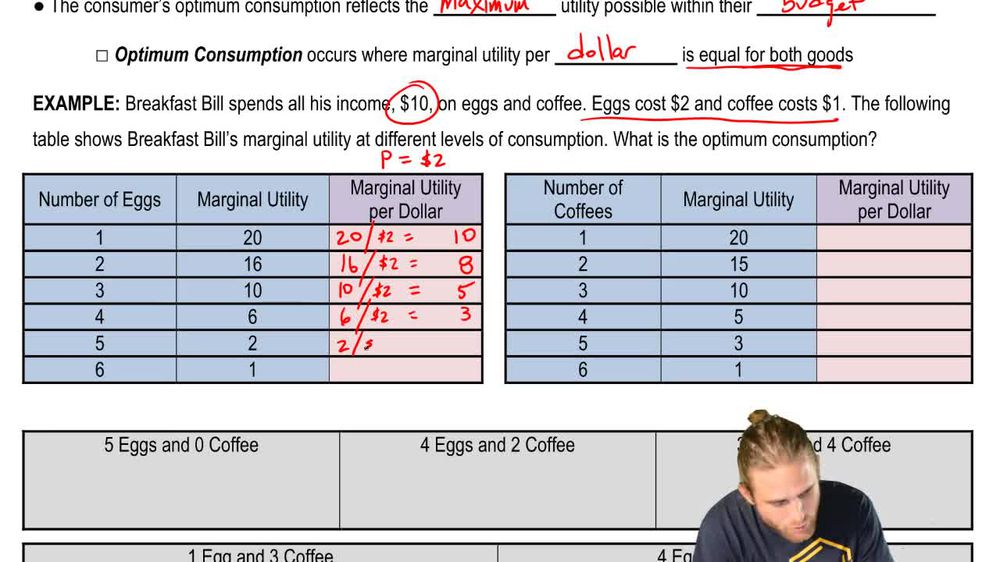
 09:38
09:38