Skip to main content
Macroeconomics
My Course
Learn
Exam Prep
AI Tutor
Study Guides
Flashcards
Explore
Try the app
My Course
Learn
Exam Prep
AI Tutor
Study Guides
Flashcards
Explore
Try the app
Back
Characteristics of Oligopoly definitions
You can tap to flip the card.
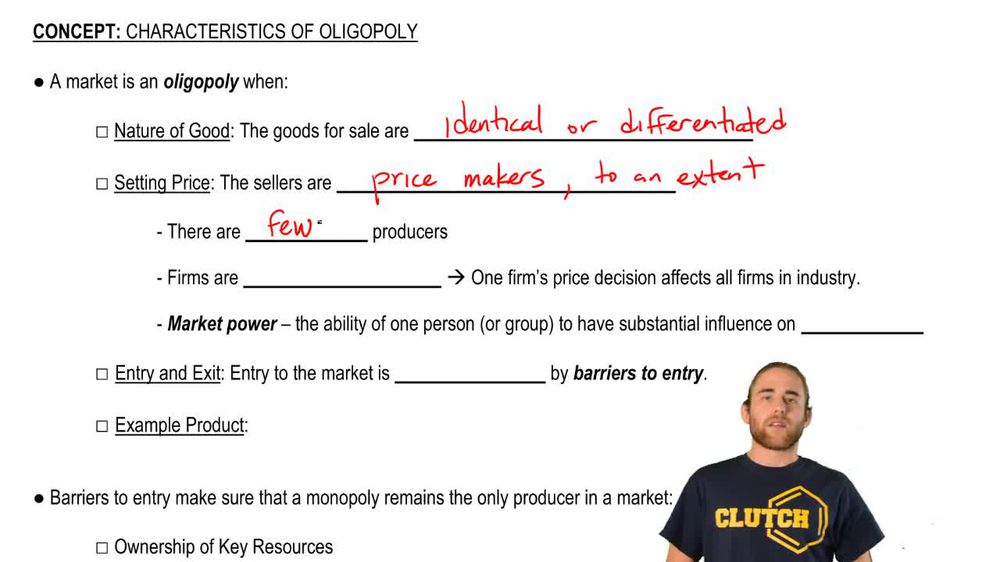
Oligopoly
You can tap to flip the card.
👆
Oligopoly
A market structure with few firms, each having significant influence over price and strategic interactions with rivals.
Track progress
Control buttons has been changed to "navigation" mode.
1/15
Related flashcards
Recommended videos
Characteristics of Oligopoly quiz
Characteristics of Oligopoly
15 Terms
Guided course
05:16
Oligopoly Barriers to Entry
Guided course
04:45
Characteristics of Oligopoly
Terms in this set (15)
Hide definitions
Oligopoly
A market structure with few firms, each having significant influence over price and strategic interactions with rivals.
Identical Goods
Products that are indistinguishable from each other, making it impossible for consumers to differentiate between suppliers.
Differentiated Goods
Products that are distinct in features or branding, allowing consumers to distinguish between competing firms’ offerings.
Market Power
The ability to influence market price and output, typically greater than in competitive markets but less than in monopolies.
Interdependence
A situation where firms must consider rivals’ actions when making decisions, especially regarding pricing and output.
Barriers to Entry
Obstacles that prevent new firms from entering a market, maintaining the dominance of existing firms.
Ownership of Key Resources
Control over essential inputs needed for production, restricting competitors’ ability to enter the market.
Government Regulation
Legal constraints, such as patents, that grant exclusive rights and restrict competition in a market.
Economies of Scale
Cost advantages achieved by increasing production, resulting in lower average total costs per unit.
Natural Duopoly
A market condition where two firms efficiently satisfy demand due to significant cost advantages from large-scale production.
Minimum Efficient Scale
The lowest production level at which long-run average total costs are minimized, often influencing market structure.
Price Maker
A firm with enough influence to set or affect market prices, unlike firms in perfectly competitive markets.
Perfect Competition
A market structure with many firms, identical products, and no single firm able to influence price.
Patent
A government-granted exclusive right to produce and sell an invention, creating a legal barrier to entry.
Aggregate Supply
The total quantity of goods and services that firms in an economy are willing to produce at various price levels.
 BackBack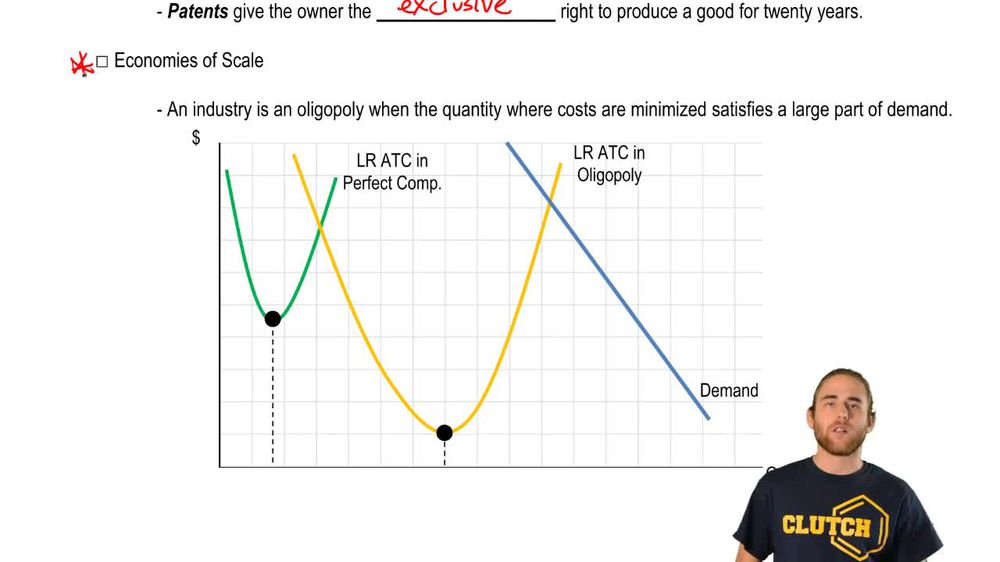
 05:16
05:16